SHIELDS OF SHAME • MARTIN COUNTY CASE NETWORK
One traffic stop. Six connected investigations.
Explore the February 13, 2025 Stuart traffic stop, each officer’s documented connection and the separate $10,300 records-fee dispute. Being at the scene does not establish wrongdoing; where the record does not show a specific action, we say so.
Records request #2371-2025: invoice, deposit demand, agency correspondence and unresolved accounting questions.
 Nicholas A. Thomas ↗
Primary deputy; authored the traffic-stop and arrest report involving passenger Giselle Flores.
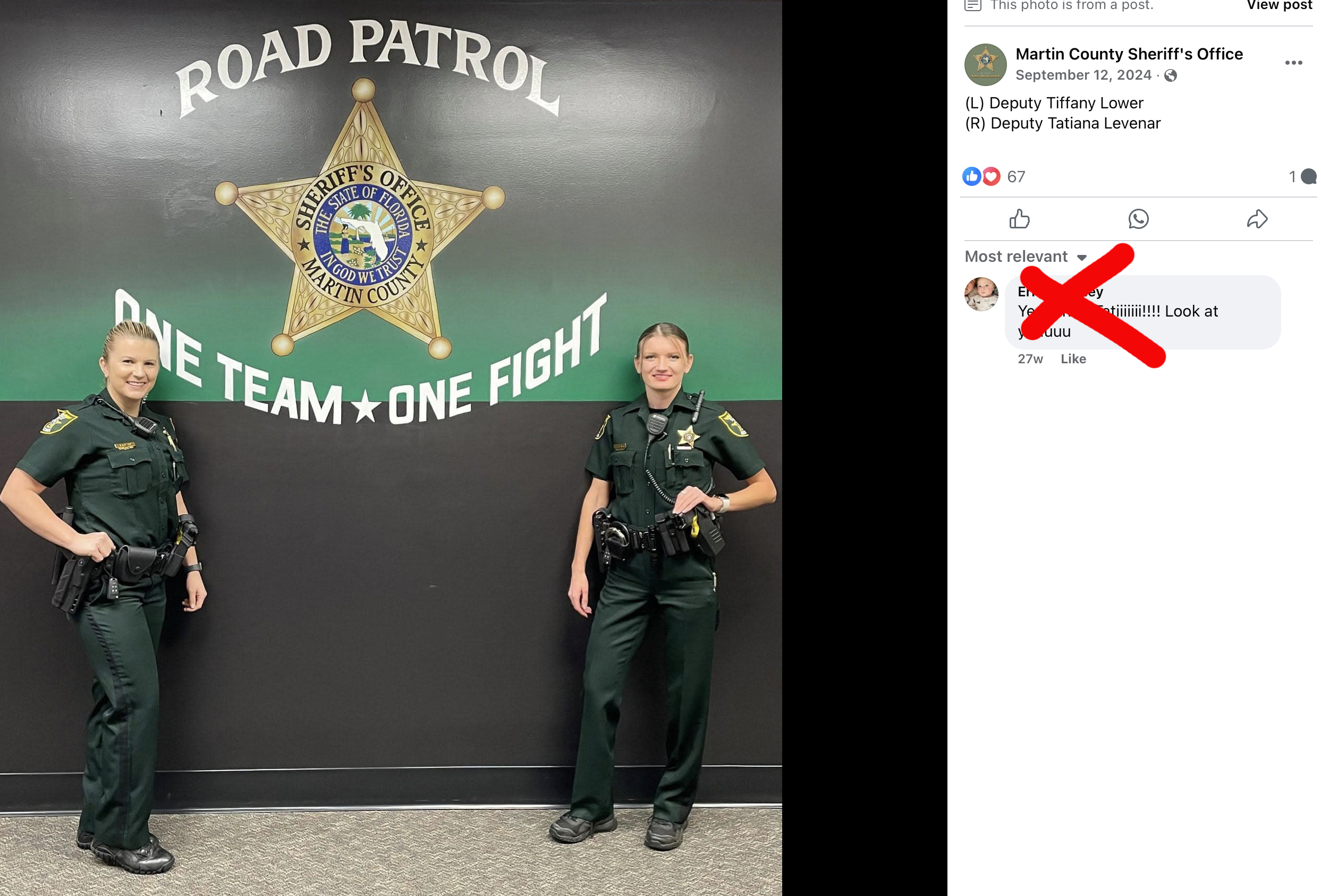 Tatiana R. Levenar ↗
Responding deputy, CAD unit 513; her actions and the reported filming dispute are examined separately.
 Adam R. Tuttle ↗
Responding deputy, CAD unit 516; the record establishes attendance, not a specific arrest action.
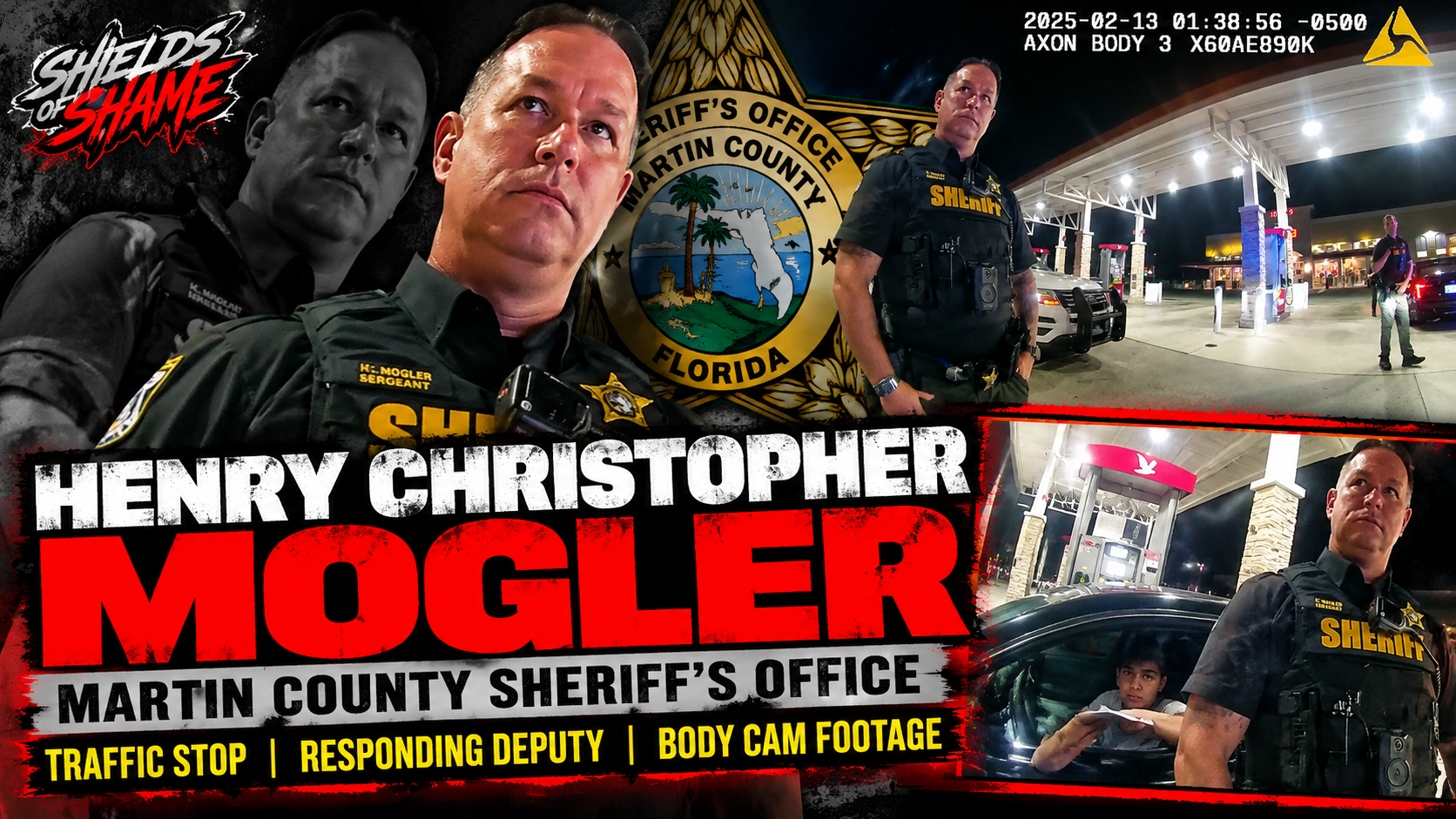 Henry Christopher Mogler ↗
S02 responding unit; arrived after a request for a supervisory unit. His decisions remain unverified.
 Crystal L. Nash ↗
Agency-identified sergeant connected through supplied scene imagery; not among the four CAD-listed units.
MARTIN COUNTY • FEBRUARY 13, 2025 • VIDEO EVIDENCE
The Reason for the Stop — Watch the Video
Watch the supplied video concerning the stated reason for the traffic stop that led to this Martin County investigation. The incident report describes modified exhaust and window tint as the deputy’s stated reasons. Compare the video with the report; a clip alone may not capture the entire encounter.
SECOND VIDEO • DEPUTY LEVENAR’S BODY CAMERA
Passenger ID Demand and Threat to Seize a Recording Phone
After Deputy Thomas initiated the February 13, 2025 stop, Deputy Tatiana R. Levenar responded to a dispute over passenger Giselle Flores providing identification. Levenar repeatedly asserted that all occupants must identify themselves and warned of jail. When driver Aiden discussed recording officers, Levenar said she did not consent and threatened to take his phone as evidence. The supplied transcription marks some remarks inaudible because of vehicle noise. These statements raise distinct questions about the legal grounds for an ID demand and First Amendment recording protections.
Open full transcribed body-camera video ↗ | Read the detailed Levenar investigation ↗
SHIELDS OF SHAME / OPEN RECORDS DOSSIER / FLORIDA
$10,300
The price quoted for Martin County Sheriff’s Office records
Martin County Sheriff’s Office quoted $10,300 for public records. The deposit letter and invoice raise a simple question: what work would that money pay for?
ORIGINAL DOCUMENTS • RECORDS LAW • CASE FILES • VIDEO CONTEXT
OCTOBER 2026 | DOCUMENTED POLICY CONTEXT
What the sheriff’s published fee schedule says
Martin County Sheriff’s Office publishes a records-fee schedule effective October 1, 2020. It lists, among other categories, $25 per processing hour for digital evidence or large video recordings, plus applicable storage media. It also describes special service charges for extensive technology use or supervisory assistance. This published schedule offers a useful comparison with the estimate in the documents below; it does not independently establish whether the $10,300 estimate was properly calculated.
Read the sheriff’s fee schedule ↗
Update status: A search of publicly available sources did not establish that the fee was paid, reduced, withdrawn or adjudicated. The status of the original FDLE follow-up request is likewise unverified.
The case: Shields of Shame reported a $10,300 quote for Martin County Sheriff’s Office records. The deposit letter and invoice are linked below.
The page also includes a separate set of incident files. The original article says the agency supplied those files at no charge. Read both groups to understand the dispute.
THE CENTRAL DISTINCTION
A large estimate deserves an itemized explanation. Its size alone does not establish that it violates Florida law.
01 / Start with the money
First, read the deposit letter and invoice together. Check what the request covered and what work the agency said it needed to do.
Then compare the hours, rates and deposit amount. The page reports a $10,300 quote. Use the original documents to check the agency’s exact terms.
- What records did the request cover?
- Which tasks required staff time?
- What hours and rates did the agency use?
- What payment did it require before releasing the records?
EXHIBIT 01 / FEE DOCUMENT
Deposit letter
The agency’s deposit demand and its stated conditions for proceeding.
EXHIBIT 02 / FEE DOCUMENT
Invoice 2371-2025-INV-1
The billing document to compare against the reported $10,300 fee.
02 / The incident behind the records
A Long Island Audit (LIA) video prompted the records request, according to the original article. LIA does not sponsor or endorse Shields of Shame.
The incident files below carry case number 2025-00021924 and dispatch number 25-21924. They form a separate group from the fee estimate. The original page says the agency supplied them free of charge.
Watch the LIA video that prompted the records inquiry →
EXHIBIT 03 / INCIDENT FILE
CAD record • 25-21924
The dispatch record associated with the underlying incident.
EXHIBIT 04 / INCIDENT FILE
Redaction log • 25-21924
The agency’s record of information withheld or obscured.
EXHIBIT 05 / INCIDENT FILE
Incident report • 2025-00021924
The redacted narrative for the incident connected to the videos.
Read the records in this order
- Compare the deposit letter with the invoice.
- Read the incident report for the agency’s account.
- Use the CAD file to follow the dispatch sequence.
- Check the redaction log for the agency’s withholding explanations.
- Return to the videos and compare claims with the documents.
SHIELDS OF SHAME • FREE AUDIT-TRAIL SAMPLE LIBRARY
Body-camera audit trails obtained without a fee
“I paid nothing for any of these sample records.” — Shields of Shame publisher
These files show the audit records SOS has received at no charge. They range from a one-day device report to a 945-page annual export.
In the publisher’s experience, these logs often need little or no redaction. Some posted samples do contain redactions. The examples support a request for a clear cost breakdown; they do not settle the legality of Martin County’s $10,300 quote.
Three kinds of logs, three different questions
- Device audit: What happened on a particular camera? Look for power, recording, docking and assignment events.
- User audit: What actions did an account take in the evidence system? Look for access, downloads, categories and retention changes.
- Platform audit: What actions occurred across a camera or surveillance platform? These can cover more than body cameras.
An audit trail is a record of system events. It is not the video itself. Compare its timestamps and wording with the footage, dispatch records and agency policy.
Axon’s guide: viewing an evidence audit trail
Agency / source: Axon Enterprise, Inc.; vendor instructions, not an agency case file.
This two-page guide explains how to create an audit report for an evidence file. It was last modified on December 4, 2024.
The steps are straightforward: open Audit Trail, select a period, run the audit, then download the PDF. The guide describes that software release. Menus may differ in another version.
It explains an evidence-file audit. It does not establish the work needed for every device, user or agency-wide request.
Device audit reports
Ashley Wood: Axon Body 2 device audit
Agency / source: Savannah Police Department, Georgia; the report identifies Ashley Wood in a device reassignment entry.
This 65-page report tracks camera X81345309. Its requested range is January 1, 2021–November 15, 2024. The header says it was generated on November 14, 2024, one day before that range ends.
The entries include firmware updates, clock checks, power events and uploads. A July 15, 2023 entry records reassignment from Wood to another user.
Read “uploaded and deleted from device” carefully. Removal from the camera after upload is different from deletion of the stored evidence.
Roberto Garibaldi: one-day Axon Body 3 audit
Agency / source: Lakeland Police Department, Florida; associated with the SOS Garibaldi case archive.
This 18-page scanned report covers September 15, 2024. It identifies Axon Body 3 camera X60A69944. OPS Detective Paula Parker generated it on November 15, 2024.
The first page logs button presses, charging connections and power changes. It also records audio being disabled due to the video-buffering default.
That buffering entry does not, by itself, prove that an officer deliberately muted audio. Read it with the camera’s recording state and the footage.
Kevin Cheillada: 2025 Axon Body 4 audit
Agency / source: Richmond County Sheriff’s Office, Georgia; Cheillada and report generator Sgt. John Perry are identified in official agency records.
This 945-page report covers January 1–December 31, 2025. It identifies camera D01AE758K. The report was generated on January 13, 2026.
It records charging, docking, power and other device events. Its heading states that confidential activity is not included. It should therefore not be treated as a complete log of all activity.
The large page count shows how extensive a generated export can be. It does not show how much staff time an agency spent producing it.
Agency context: Cheillada’s official promotion notice and Richmond County’s Internal Affairs directory.
207-page Axon Body 2 sample: camera X81165689
Agency / source: Upload labeled “Wrens”; the report header does not identify an agency. Origin needs confirmation.
This is the comparison report previously described on this page. It is now available below. It covers May 22–August 31, 2023, and was generated on September 18, 2023.
Gerard Lampiasi generated the report. An early entry logs reassignment from Ciara Devane to Sgt. Dawn Harris, badge 5140. The report includes clock synchronization, firmware and docking events.
Source-label discrepancy: the filename says Wrens, but the named staff align with Bunnell, Florida records. The export itself does not settle its agency of origin. SOS preserves the supplied filename while awaiting the source correspondence.
Supporting context: Bunnell’s May 2023 staff report and Bunnell staff reporting.
User audit and history reports
Travis Braswell: user audit trail
Agency / source: Wrens Police Department, Georgia; the report names Braswell and shows a Wrens clerk account as the generator.
This 57-page report covers August 21–November 14, 2024. It was generated on November 14, 2024.
Unlike a camera device log, this export follows an evidence-system user. Entries include category changes, titles, retention updates and audit downloads.
A scheduled deletion date is a retention setting. It is not proof that a file was actually deleted on that date.
Nathan Smith: September 2024 user history
Agency / source: Lakeland Police Department, Florida; linked to the SOS Lakeland case archive.
This 37-page report covers September 1–30, 2024. Corey Bouillez generated it on June 24, 2025. It identifies Nathan Smith, badge 23467.
The table gives the date, action, user and evidence fields. Early entries include a successful login and remote device unassignment. The supplied PDF is marked Redacted.
Use it to follow account activity. It answers a different question from a camera’s power or recording log.
Kenneth Vanderpool: September 2024 user history
Agency / source: Lakeland Police Department, Florida; linked to the SOS Vanderpool case archive.
This 52-page report covers September 1–30, 2024. Corey Bouillez generated it on June 16, 2025. It identifies Kenneth Vanderpool, badge 22262.
Entries identify evidence titles, actions and ownership fields. They refer to both Axon Body 3 footage and Axon Fleet 3 front-camera footage. The PDF is marked Redacted.
This sample shows why a user history can help connect body-camera and vehicle-camera records.
Source context for the Lakeland samples: SOS Lakeland case archive.
Atlanta Police: platform audit exports in CSV format
These files identify the clients as fususONE and fususOPS. They include surveillance-camera activity and license-plate-related events. They are broader platform logs, not Axon body-camera device reports.
Both contain 21 columns. These include timestamps, operations, users, organizations and object details. The files are large; download them before filtering or searching. Counts below exclude the header row.
Atlanta PD: January 2024 audit export
Agency / source: Atlanta PD – GA appears in the organization fields; the export also includes other user organizations.
This CSV contains 612,722 data rows for January 2024. It is about 284 MB.
Operations include live viewing, recorded viewing, camera movement and logins. It also contains 18,431 rows labeled LPR_READ. Those are not all manual plate searches.
A log row is not automatically a separate incident or evidence of misuse. Check the action type, user and supporting record.
Atlanta PD: August 2024 audit export
Agency / source: Atlanta PD – GA appears in the organization fields; fususONE and fususOPS are the listed clients.
This CSV contains 214,059 data rows for August 2024. It is about 93 MB.
Operations include live viewing, recorded viewing, camera movement and clip downloads. It contains 6,497 rows labeled LPR SEARCH.
That count does not establish unauthorized searches. It also should not be compared directly with January’s LPR_READ count. The action labels describe different events.
Cherokee County: Mills–Lopez investigative dossier
Agency / source: Shields of Shame reporting about Cherokee County Sheriff’s Office, Georgia.
This nine-page SOS dossier is dated September 23, 2026. It concerns Natasha Lopez, Corporal Charles Aaron Mills and a disputed home entry.
It explains how camera records and audit timestamps can be compared with footage, dispatch audio and other evidence. It references Axon Body 3 and Body 4 reports.
This file is an editorial dossier, not a raw Axon audit export. It offers a practical example of audit records supporting a wider investigation.
Visual guide: reading an Axon Body 2 audit
This SOS graphic introduces the columns and common event types using pages from the 207-page sample. Click it to open the full-size image.

Read the exact event: power changes and dock connections are separate events. A gap does not prove a policy breach. A firmware check does not, by itself, prove that the camera worked properly.
Use the original report to test the graphic’s simplified explanations. Match the report’s time zone and recording state to the other evidence.
How to ask for a useful audit report
- Specify the report type: device, user or evidence-file audit.
- Give the officer, device or evidence identifier and date range.
- Ask for the existing export format, such as PDF or CSV.
- If fees are quoted, request the tasks, hours and rates behind them.
- If fields are withheld, ask the agency to identify its legal basis.
These are examples of records supplied to SOS without a fee, according to the publisher. The filenames and reports do not independently document the billing history.
The samples vary in scope and format. Some are redacted, and one excludes confidential activity. None establishes that Martin County’s request required the same work. They give readers concrete records to compare with the agency’s explanation.
03 / What Florida law actually allows
Florida Statutes § 119.07 provides access to public records. It also allows a reasonable special service charge in some cases.
The nature or volume of a request must require extensive use of technology, clerical help or supervisory help. The charge must reflect costs actually incurred or attributable to that work. The law does not allow an agency to choose an arbitrary price.
The Florida Attorney General explains that using technology alone does not justify an extensive-use charge. The key question is how much work the request requires.
That guidance helps readers assess the estimate. This page does not report a court ruling that found this fee unlawful.
Read Florida Statutes § 119.07 →
Read the Florida Attorney General’s guidance on electronic-records charges →
Martin County Sheriff’s Office: records information →
04 / Follow-up and outstanding records
The original page listed a Florida Department of Law Enforcement (FDLE) request as outstanding. That was its reported status when the material was posted. Its current status has not been verified.
05 / Related reporting, separate incidents
Other reporting has examined Martin County Sheriff’s Office. The cases below provide agency context.
They do not prove that the $10,300 estimate was unlawful. Their inclusion also does not establish a link between the events.
- Steven O’Leary: reporting on falsified drug arrests and resulting civil-rights claims. Washington Post coverage → Lawsuit coverage →
- Ryan Grimsdale: reporting on allegations involving billed off-duty supervisory shifts. WPTV coverage →
- David Sosa: repeated mistaken-identity arrests and litigation. Read the Eleventh Circuit opinion →
Watch the Jeff Gray video referenced in the original page →
06 / Questions for the agency
- Which portions of the requested records required extensive work?
- How were projected staff hours and hourly rates calculated?
- What portion of the estimate was for locating, reviewing, redacting or copying records?
- Could the request be narrowed or produced in stages at a lower cost?
- Was the final charge different from the original estimate?
The documents are the story
Inspect the original records above and compare them with the videos and legal sources. For more records-based investigations, explore Shields of Shame.
Editorial note: This page separates agency records, video accounts, allegations and open questions. A fee quote does not prove that anyone paid it. Nor does it prove that a court found it unlawful. The document links preserve the files attached to the original page.
October 2026 document audit: the missing fee breakdown and agency correspondence
Original request: March 24, 2025, concerning Tatiana Levenar, Crystal Nash, Nicholas Thomas and Adam Tuttle, seeking Garrity/Miranda warnings, service photographs, AXON audit trails and public complaints. On March 28 the requester offered to narrow the audit period to August 2024 onward; on March 31 the requester changed the proposed start to January 2024. This narrowing occurred before the April 8 invoice.
April 8 letter signed by Records Assistant Manager Paige Walsh: the Sheriff’s Office estimated $10,300 and 412 hours, and stated processing would start after receipt of 50% of the estimate ($5,150). The letter says actual costs could be reconciled against the deposit, while also describing payments as nonrefundable after payment. Invoice 2371-2025-INV-1, created and due April 8, lists $10,300 for extensive agency-resource use.
What the attached time chart actually itemizes
| Public records coordinators — review and redact | 204 hours |
| Research | 1 hour |
| Compile AXON audit reports | 3 hours |
| Internal Affairs — compile records | 45 minutes |
| Legal adviser meeting | 30 minutes (marked FREE) |
Reconciliation question: The named tasks add up to 208 hours 45 minutes excluding the free meeting (209 hours 15 minutes including it), not 412 hours. This is a discrepancy between the printed summary and its visible itemization; it does not prove what work was ultimately performed or whether some time was omitted from the chart. The $10,300 divided by 412 hours equals $25 per stated hour, but the agency did not reconcile the missing hours in this chart.
April 9: the Records Unit responds
Rachel Molina said the narrowed AXON search took three hours to gather and yielded 5,630 pages requiring what she described as a 30-second-per-page cursory review. She also described 30 complaint PDFs, an estimated 17 hours to review them thoroughly, and 45 minutes of IA compilation. At 30 seconds per page, 5,630 pages would equal approximately 46 hours 55 minutes of review, which does not independently explain the chart’s 204 review/redaction hours. That comparison assumes the same pages and task scope and therefore remains a question, not a finding of improper billing.
Molina also wrote that the office had no responsive Garrity/Miranda warnings or service photographs for the request. These are the agency’s statements about responsiveness, not proof such records never existed. She said a checklist had been supplied and maintained that review/redaction charges applied. After the requester asked to escalate the matter, Sergeant Daniel X. DuLac, identifying himself as supervisor of the Records Unit, emailed on April 9 offering telephone contact. His email does not establish a fee reduction, reversal or legal ruling.
Request status: Molina’s April 8 message asked for a response by April 21 or the request would be closed. The uploaded correspondence does not prove whether the agency ultimately closed the request. One attempted message to an attorney-general address bounced as undeliverable; the correspondence separately shows a complaint sent to other recipients. A bounced email should not be described as a complaint successfully received by that address.
How the incident documents fit
Verified source distinction: The 11-page CAD lists Thomas (512, 1:20 a.m.), Levenar (513, assigned 1:21 a.m.; on scene 1:27 a.m.), Tuttle (516, 1:28 a.m.) and Mogler (S02, dispatched 1:32 a.m.; on scene 1:38 a.m.). It does not list Crystal Nash as one of those four assigned units. A supplied body-camera still and separate agency material are the basis for Nash’s related profile; a still alone cannot establish her decisions or actions.
The CAD also records unit 512 requesting S01 or S02 at 1:33 a.m., unit 512 heading to jail at 1:49 a.m. and arriving at 1:50 a.m. Units 513 and 516 cleared at 1:51 a.m.; S02 cleared at 1:55 a.m.; unit 512 cleared at 3:25 a.m. At 3:27 a.m., the CAD disposition was changed to show eight traffic citations. The available incident narrative explicitly identifies a seat-belt citation to passenger Giselle Flores; the CAD’s count alone does not establish the recipients, offenses or outcomes of all eight citations.
Read 11-page CAD ↗Read four-page incident report ↗
Redaction log: The supplied log checks categories concerning driver’s information, Social Security numbers, motor-vehicle/DAVID information and NCIC/FCIC criminal-justice data. These are recorded withholding categories; the log alone does not establish whether every redaction was legally necessary. A separately uploaded CAD version contains more identifying data than another version. For public distribution, SOS should favor the redacted copy and avoid republishing unnecessary identifiers.
Reporting standards: The officer’s narrative is an account, not a judicial finding. The traffic-citation docket separately identifies the Flores seat-belt citation as dismissed by the officer; the misdemeanor case requires its own docket verification before stating a final criminal outcome.