Shields of Shame · Open investigative case file · Federal civil rights
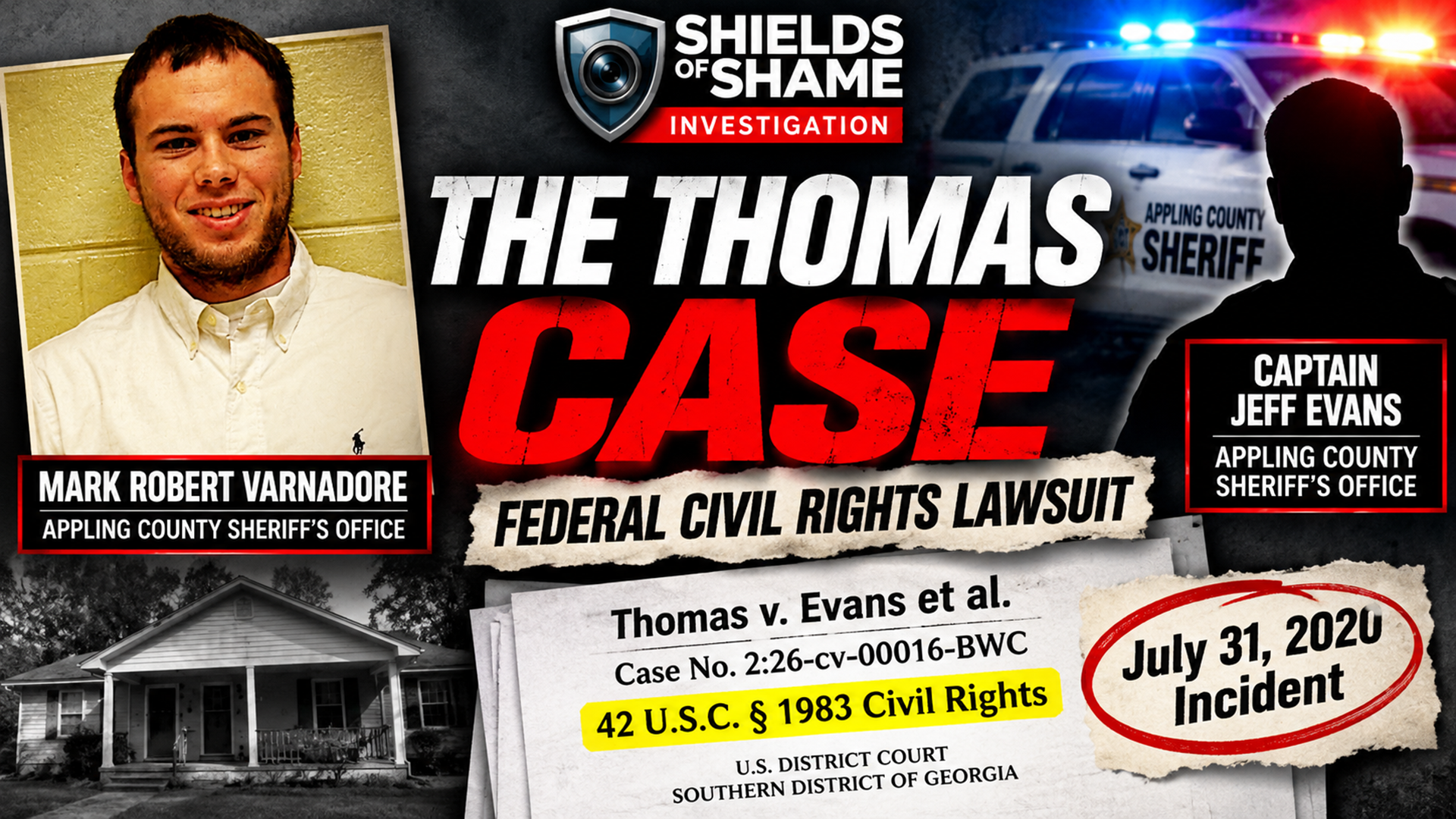
THE THOMAS CASE
A disputed entry into a Georgia home. A police report describing consent. A plaintiff who says the body camera tells a different story. And a $7 million demand that has not been awarded.
Sean Christopher Thomas v. Jeff Evans, Mark Varnadore and Appling County Sheriff’s Office
Surviving case: 2:26-cv-00016-BWC
Related consolidated case: 2:26-cv-00021-LGW-BWC
Federal court: Southern District of Georgia, Brunswick Division
Incident: July 31, 2020 · Approximately 10:19 a.m. · 129 Kersey Street, Baxley, Georgia
Lawsuit filed: February 6, 2026
Case status note: The PACER history supplied to Shields of Shame shows entries through November 4, 2026, without a visible merits judgment in the surviving action. This is not a guarantee that no later filings exist.
The story: what happened at the house?
On July 31, 2020, investigators arrived at a residence in Baxley during a narcotics investigation. Sean Christopher Thomas alleges that Captain Jeff Evans and Investigator Mark Varnadore entered without a warrant, valid permission, or emergency circumstances. He alleges the official narrative is contradicted by body-camera footage.
The officer-written report tells a different story. It describes Leah Thomas allowing an investigator to enter through a carport door, followed by Sean Thomas reportedly giving verbal permission to search the home and a Chevrolet truck and signing a consent form at approximately 10:23 a.m. The report says suspected drugs were discovered. Those assertions are the officers’ account, not independent findings adopted by this publication.
The four-minute question
Thomas places the officers’ arrival or entry at approximately 10:19 a.m. The report describes a signed search-consent form at about 10:23 a.m. Was the initial entry separately authorized? Who said what at the doorway? What does the recording actually show? Consent to enter and consent to search are different legal questions, and a later signature does not by itself resolve the legality of an earlier entry.
Who is named?
Captain Jeffrey W. Evans
Named as a defendant in Thomas’s federal complaint. No verified Evans photograph is included in the supplied assets. His Georgia POST training record is provided below for public examination.
Investigator Mark Robert Varnadore

Named as a defendant and identified in the report describing the entry and search. His training record is available for independent review.
A Georgia POST training record documents certification and training information; it does not by itself determine whether conduct in a particular incident was lawful.
What does a $7 million lawsuit mean?
Thomas requested approximately $7 million in punitive damages, with $3.5 million directed at each of the two individually named officers in the complaint. That figure is a request by the plaintiff, not a settlement, verdict, or payment. A civil-rights complaint under 42 U.S.C. § 1983 permits allegations of violations of federal rights by people acting under color of state law. Whether any defendant is liable must be decided through the legal process.
Timeline of the case
- July 31, 2020: Disputed entry and search in Baxley.
- February 6, 2026: Thomas files the original federal complaint, case 2:26-cv-16.
- March 4, 2026: A related complaint and correction filing appear.
- March 13, 2026: Court consolidates duplicate actions, allows a correction, and grants requests to proceed without prepaying fees.
- March 16, 2026: Judgment closes only the duplicate case 2:26-cv-21.
- March 30–31, 2026: Fee consent and assessment entered in the surviving case.
- August and November 2026: The supplied PACER screenshot shows prisoner-fee entries, not a decision on the constitutional allegations.
Evidence library: every court document explained
Each item below explains what the document does, why it matters, and what readers should not conclude from it. All buttons open the original supplied PDFs in a new browser tab. Some records appear twice because the same order was filed in both consolidated dockets or because duplicate copies were provided.
Public record 1 of 12
Document 1 · Original complaint · February 6, 2026
The original federal civil-rights complaint presents Thomas’s account of the July 31, 2020 entry and search. It is the starting point for understanding what he alleges, whom he sued, and the relief he requested. The attached incident report gives investigators an officer-written account to compare with any footage.
What this does not establish: An allegation in a complaint is not a judicial finding.
Public record 2 of 12
Document 7 · Correction to complaint · March 4, 2026
Thomas submitted a correction to his complaint, including the erroneous reference to Newton County and identification of Appling County. This explains why different county names may appear in earlier paperwork.
What this does not establish: The correction was allowed by the court; it does not decide the underlying search issue.
Public record 3 of 12
Related case Document 1 · Duplicate complaint · March 4, 2026
A second complaint filed as case 2:26-cv-00021-LGW-BWC concerned the same events. Reading both complaints helps explain why the court later consolidated the cases.
What this does not establish: This is a separate docket number, not a separate proven incident.
Public record 4 of 12
Document 10 · Consolidation and amendment order · March 13, 2026
The court found the two complaints duplicative, directed their consolidation under case 2:26-cv-00016-BWC, ordered the related case closed, and granted Thomas’s requested correction.
What this does not establish: Consolidation is procedural, not a decision that either side won.
Public record 5 of 12
Related case Document 4 · Consolidation order · March 13, 2026
The consolidation order also appears in the related case’s docket. It documents why case 2:26-cv-00021 was closed and why readers should follow case 2:26-cv-00016 for subsequent developments.
What this does not establish: This is a duplicate docket filing of the consolidation order.
Public record 6 of 12
Document 12 · Motion to proceed without prepaying fees · March 13, 2026
A filing in the surviving action relating to Thomas’s request to proceed in forma pauperis, meaning without prepaying the full federal filing fee. It is relevant to access to the court, not proof of the underlying constitutional claim.
What this does not establish: Administrative filing; no merits finding is implied.
Public record 7 of 12
Document 14 · Order granting fee-prepayment motions · March 13, 2026
The magistrate judge granted the requests to proceed without prepaying fees, required account and consent forms, and explained the Prison Litigation Reform Act payment rules and potential screening issues.
What this does not establish: The order explicitly does not decide whether the complaint should be dismissed on screening.
Public record 8 of 12
Document 13 · Magistrate judge assignment information · March 13, 2026
This document explains the process for consenting to a magistrate judge to handle a case, including trial and judgment if all parties agree. It also explains the magistrate judge’s pretrial role absent unanimous consent.
What this does not establish: Not evidence that all parties consented or that a trial was set.
Public record 9 of 12
Document 16 · Consent to collection of fees · March 30, 2026
Thomas signed the authorization allowing installment collection of filing fees from his prison trust account. It shows compliance with a procedural requirement for proceeding without prepayment.
What this does not establish: Not a settlement or payment of damages.
Public record 10 of 12
Document 18 · Initial filing-fee assessment · March 31, 2026
The court assessed a $41 initial partial filing fee toward the $350 filing fee and outlined subsequent monthly deductions from the prison account.
What this does not establish: The assessment is not a ruling on the allegations.
Public record 11 of 12
Related case Document 5 · Judgment closing duplicate case · March 16, 2026
The judgment closed related case 2:26-cv-00021 following consolidation. It must be read alongside the order transferring the duplicate filings to the surviving case.
What this does not establish: Do not report this as dismissal on the merits of the surviving lawsuit.
Public record 12 of 12
Additional copy · Fee collection consent
An additional supplied PDF with the same base filename as the fee-consent filing. It is provided for public access; compare with Document 16 to confirm whether it is an exact duplicate.
What this does not establish: Duplicate-looking file; no separate court ruling should be inferred.
How to read these court records
Complaint versus finding
A complaint states what a plaintiff alleges. A police report states what its author recorded. Neither is automatically an independently verified account. A judge’s procedural order may address paperwork, consolidation, or fees without ruling on whether officers violated anyone’s rights.
Why one case was closed
The March 16 judgment concerns duplicate case 2:26-cv-21. The court consolidated its filings into 2:26-cv-16. Reporting the duplicate closure as a victory for either side would misrepresent the order.
What a fee order means
Permission to proceed without prepaying the full filing fee does not mean a court has approved the allegations. The $41 initial assessment concerns litigation costs, not compensation to Thomas.
What evidence is still missing?
- Original unedited body-worn camera footage from Evans, Varnadore, and other responding officers.
- Consent-to-search form and documentation of the circumstances in which it was signed.
- Dispatch, CAD, supplemental reports, and any warrant materials.
- Related criminal court records, including any motion challenging the search.
- Any later substantive orders or disposition in surviving case 2:26-cv-16.
Shields of Shame is pursuing these records to test the accounts against contemporaneous evidence. Until then, the legality of the entry and search remains disputed, not established.
Reporting standards and legal disclaimer
This case file is published for journalism, public education, and examination of government records. All allegations are attributed. No allegation is presented as a finding of misconduct, and no requested damages are presented as an award. People named in civil litigation are presumed not liable unless liability is established through the applicable legal process. Readers should consult the full source documents and subsequent docket entries. Corrections and additional verified records are welcome.
Shields of Shame · The record is the story
More from the Appling County investigation
Another Shields of Shame case file examines a separate incident involving the same sheriff’s office: the July 10, 2023 pursuit of Jacob Matthew Brice, Sergeant William J. Coleman’s Taser deployment, and Brice’s subsequent complaints of head pain and breathing difficulty. The Brice story centers on pursuit decisions and force; Thomas’s case centers on the legal basis for entering and searching a residence. The people, allegations, and evidence are different. Their shared agency is a reason to examine records carefully, not evidence that one incident proves the other.
Additional reporting: an earlier encounter involving Captain Evans
On June 28, 2019, WTOC reported that Captain Jeff Evans was recovering after an arrest at a Flash Foods store on South Main Street in Baxley. The report described a struggle involving Derrick Morris, who was reportedly wanted on drug-related offenses. During the struggle, a deputy’s firearm discharged; neither Evans nor Morris was struck by gunfire. Evans reportedly received treatment for a shoulder injury. WTOC reported that the Georgia Bureau of Investigation had been called in to investigate.
Why does this matter to the Thomas case? It places Evans in another publicly documented law-enforcement encounter before the disputed 2020 entry. But the incidents are not interchangeable. The 2019 news account does not establish misconduct, a disciplinary finding, or the outcome of any GBI review. The investigative next step would be to obtain the GBI file and agency review, not to draw conclusions from the headline.
Independent court indexing: what consolidation really means
The public Justia docket for case 2:26-cv-00021 records the March 13, 2026 consolidation order and March 16 judgment closing that duplicate action. The court did not decide the legality of the Thomas residence entry through that procedural judgment. For the underlying allegations, readers must follow the surviving case 2:26-cv-00016 and its subsequent substantive orders. This distinction matters: a docket entry titled “Judgment” can sound final even when it closes only a duplicate filing.
Read independent Justia docket historyRead public consolidation judgment