Shields of Shame · Appling County investigations · Court record archive
THE BRANDON O’NEAL KING CASE
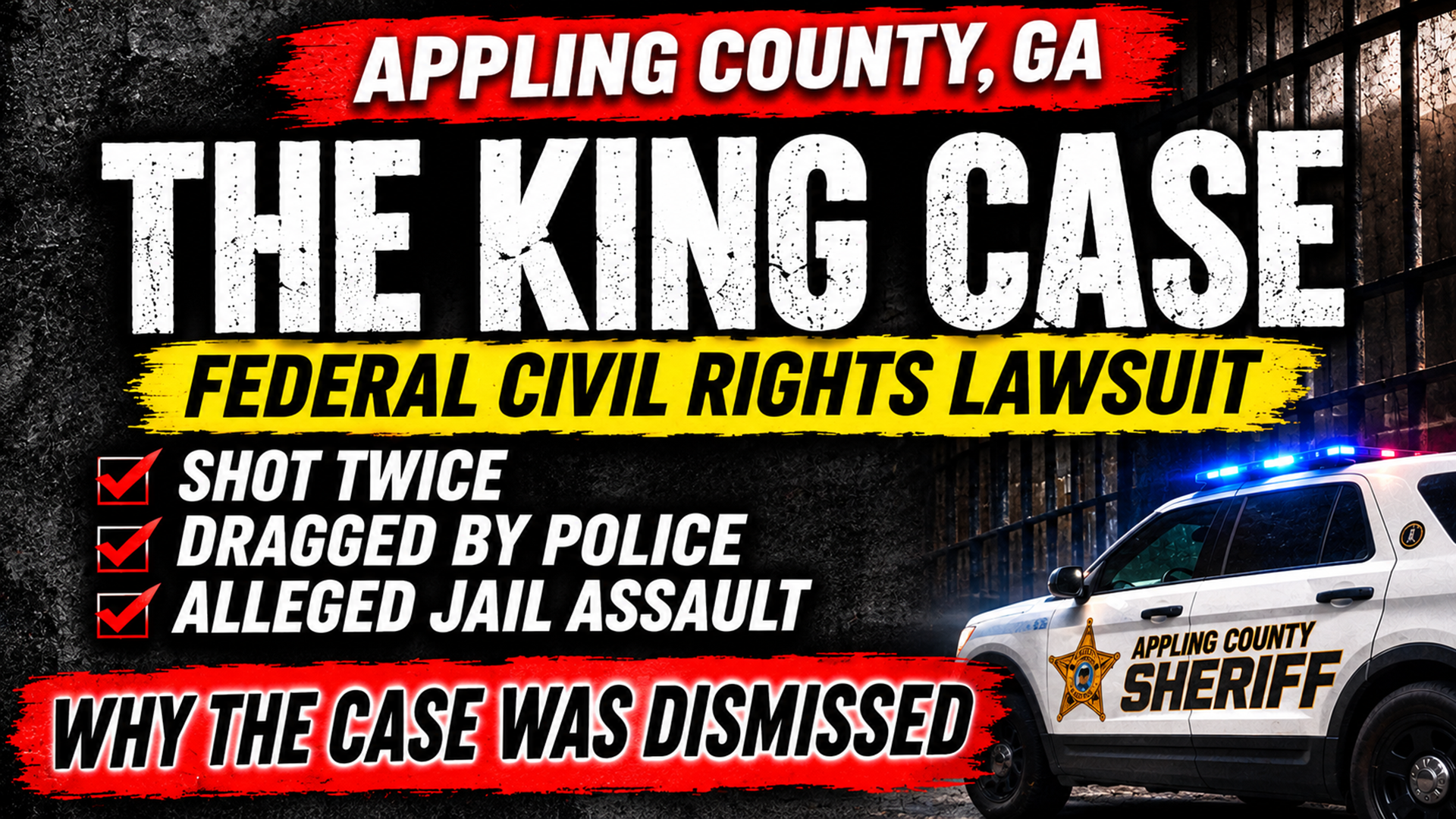
Shot twice. Recovering from surgery. A disputed detention. And a federal civil-rights lawsuit that ended without a trial verdict.
Brandon O’Neal King v. Appling County Sheriff’s Department et al.
U.S. District Court, Southern District of Georgia
Case No. 2:21-cv-00106-LGW-BWC
Key dates: December 3 and December 15, 2020
Judgment: September 12, 2023
This page distinguishes King’s allegations from the evidence referenced by the court and the actual judicial disposition. The lawsuit’s outcome does not establish every allegation was false or every action justified.
Chapter one: the December 3 shooting
According to King’s federal filings, he was shot twice during an encounter inside an apartment on December 3, 2020. He alleged that responding officers placed him on a blanket and dragged him downstairs before he received medical care. This episode matters because it supplies the medical background for the events that followed. It is important to distinguish the original shooting, the actions of responding officers, and any later detention. The complaint is King’s account; independent emergency-response footage, medical records, and incident reports would be needed to establish the full sequence.
Chapter two: a return on December 15
Less than two weeks later, King returned to retrieve his truck. He alleged that Stuart Boyer and Robert McCullough detained him and forced his hands behind his back despite his recent surgery, reopening stitches and disturbing a feeding tube. His federal Fourth Amendment claims involving these officers were initially allowed to proceed. That initial permission to proceed is not a finding of liability. It means the allegations were not disposed of at that preliminary stage.
The later litigation placed particular emphasis on the encounter’s objective evidence. An August 2, 2023 court order identifies body-camera footage and a search warrant submitted as exhibits by Boyer and McCullough. That is a critical lead: the public should be able to compare the officers’ account, King’s allegations, the warrant, and the recorded encounter rather than relying on any single narrative.
Chapter three: the separate jail allegation
King also alleged that Zeal Sharpe used excessive force against him during incarceration at the Appling County Detention Center. This is a separate event from the two December roadside or apartment incidents, and its exact date should be established from detention records. The claim implicated the Eighth Amendment and was ultimately dismissed without prejudice because King had not exhausted available administrative remedies. That procedural ground does not amount to a judicial determination that the alleged force did or did not happen.
What the federal court decided
September 11–12, 2023: final disposition
On September 11, 2023, the court granted summary judgment to Stuart Boyer and Robert McCullough. A summary-judgment ruling resolves claims without a trial when the governing legal standard is met on the record presented. The claim involving Zeal Sharpe was dismissed without prejudice for failure to exhaust administrative remedies. Final judgment was entered September 12, 2023, closing the case.
Why the distinction matters: The outcome for Boyer and McCullough was summary judgment. The outcome for Sharpe was a procedural exhaustion dismissal. Those are different rulings with different legal meanings. The public should not confuse either with a jury verdict, a criminal acquittal, or an independent investigation of every allegation.
Timeline
- December 3, 2020: King is shot and later alleges improper handling by responders.
- December 15, 2020: Encounter involving Boyer and McCullough after King returns for his truck.
- 2021: King files federal civil-rights litigation.
- August 2, 2023: Court order discusses body-camera footage and search-warrant evidence.
- September 11, 2023: Summary judgment and exhaustion rulings entered.
- September 12, 2023: Final judgment closes the case.
Original court documents: read the evidence
Each button opens the supplied original PDF in a separate tab. Where a document’s content has been established, the description explains its role. Other records are labeled for review rather than assigned an invented description. Some files may be related attachments, orders, or exhibits whose precise content must be confirmed directly.
Evidence library · 1 of 13
Original complaint
The initial filing sets out King’s allegations and identifies the defendants and requested relief. Read it as the plaintiff’s account, not a court finding.
Evidence library · 2 of 13
Complaint attachment 1
Supporting material filed with the original complaint. Its precise contents require verification against the PDF; the attachment is preserved here without guessing what it proves.
Evidence library · 3 of 13
Complaint attachment 2
Additional supporting material from the original filing. Readers can compare it with the complaint; its exact evidentiary contents have not been independently verified.
Evidence library · 4 of 13
Court filing — Document 13
An early filing in the federal docket. The specific motion, order, or exhibit title must be confirmed from the PDF before an accurate document-level analysis can be published.
Evidence library · 5 of 13
Court filing — Document 25
A docket filing preserved for public review. Its contents and procedural effect remain to be verified against the actual PDF.
Evidence library · 6 of 13
Court filing — Document 43
A later court record in the litigation. Its title, arguments, and outcome are not established by its filename alone.
Evidence library · 7 of 13
Court filing — Document 65
A document from the later stages of the federal case. The original is linked; a specific summary awaits verification.
Evidence library · 8 of 13
Court filing — Document 81
A numbered docket filing. The PDF should be examined before attributing arguments or findings to it.
Evidence library · 9 of 13
Court filing — Document 82
A separate numbered filing. Its precise role in the proceedings has not yet been verified.
Evidence library · 10 of 13
Document 95 — August 2, 2023 order
This court order discusses body-camera footage and a search warrant submitted as evidence by Boyer and McCullough. Those exhibits are key leads for obtaining and examining the underlying recordings.
Evidence library · 11 of 13
Court filing — Document 96
A subsequent docket filing. Its content and legal significance require review of the PDF itself.
Evidence library · 12 of 13
Court filing — Document 100
A late-stage docket filing. Do not infer its contents from the sequence number; the PDF is linked for verification.
Evidence library · 13 of 13
Final judgment — September 12, 2023
The final judgment formally closes the federal action following the September 11 decision. This is a court disposition, not proof that every factual allegation was false.
Questions the record still raises
- What did the December 3 response recordings and emergency medical records document?
- What do the December 15 body-camera footage and search warrant show about the officers’ authority and actions?
- What medical limitations did the officers know about when restraining King?
- What do jail surveillance, incident reports, and grievance records show about the separate Sharpe allegation?
- Can the federal court exhibits be obtained in their original recorded format?
Related Shields of Shame investigations
Thomas v. Evans
In a separate 2020 incident, Sean Christopher Thomas alleges unlawful entry and search of his Baxley residence. The case names Captain Jeff Evans and Investigator Mark Varnadore. This is a different encounter with different allegations and a separate federal docket.
Jacob Matthew Brice
A July 10, 2023 pursuit involving Sergeant William Coleman led to a Taser deployment and Brice’s subsequent hospital complaints. The four-part video investigation and agency records are available in a separate case file.
What these three cases do and do not show
The King, Thomas, and Brice investigations involve Appling County law enforcement but concern separate incidents, officers, allegations, and outcomes. Their presence in one investigative collection is not proof of a departmental pattern or of misconduct in any particular case. Connecting them allows readers to compare official procedures, record availability, court decisions, and how the evidence was evaluated.
Reporting standards and legal disclaimer
Shields of Shame publishes court filings and official records for public education and accountability reporting. Allegations are attributed to their sources and are not presented as established facts. A complaint is not a finding, and a procedural dismissal is not the same as a trial verdict. Any corrections, updated orders, or verified additional evidence should be incorporated into the record. This material is journalism, not legal advice.
Shields of Shame · On the record