
By Shields of Shame Investigations
Agency: Houston County Sheriff’s Office, Georgia
Officer: Tanisha L. Green
Georgia POST number: O228423
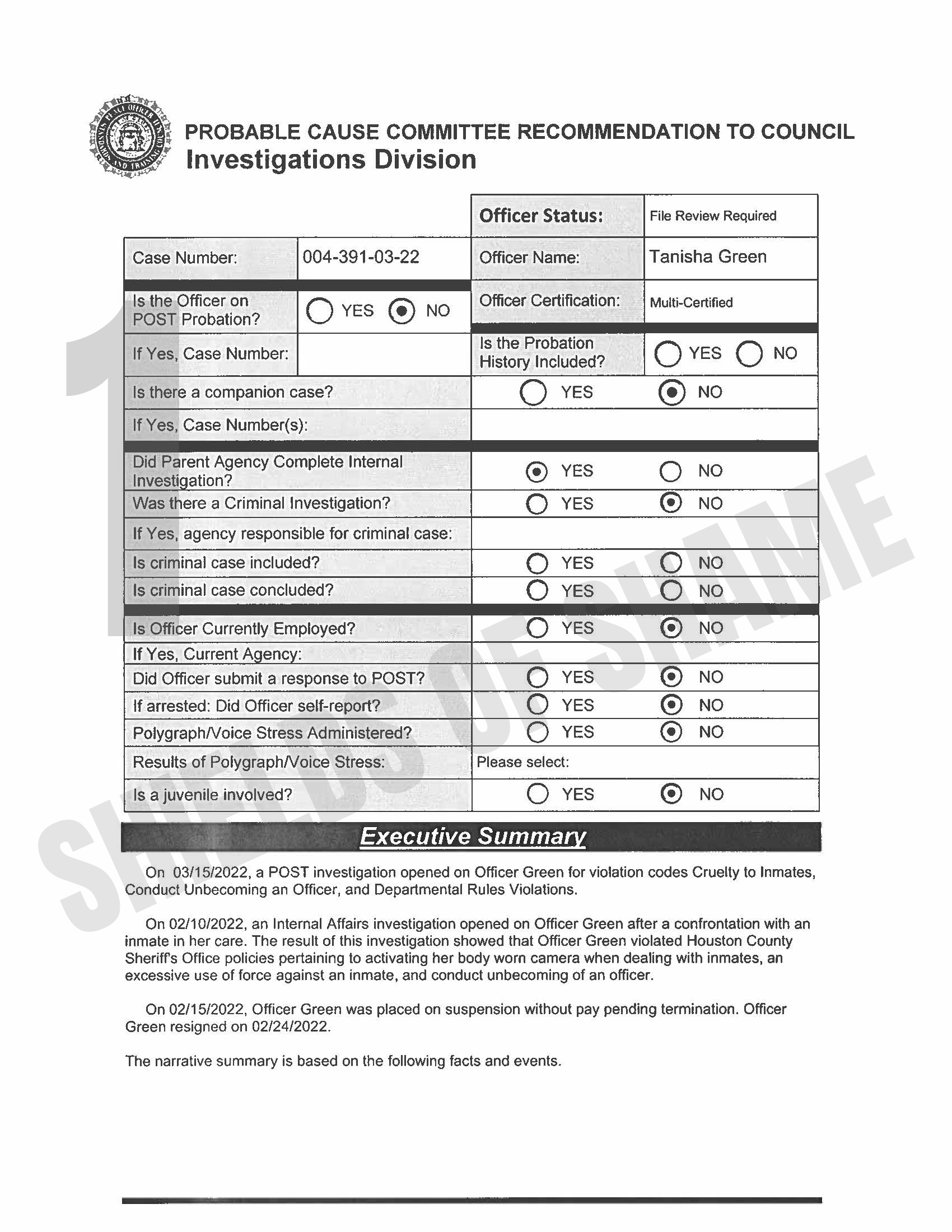
POST case: 004-391-03-22
Incident date: February 9, 2022
Final sanction: Both certifications revoked January 13, 2024

A broken toilet, a punishment, and a confrontation that should never have happened
A Houston County jailer opened an inmate’s cell door and confronted him after he insulted her, then pushed him twice and struck him in the face, according to a Georgia Peace Officer Standards and Training Council case summary obtained by Shields of Shame.
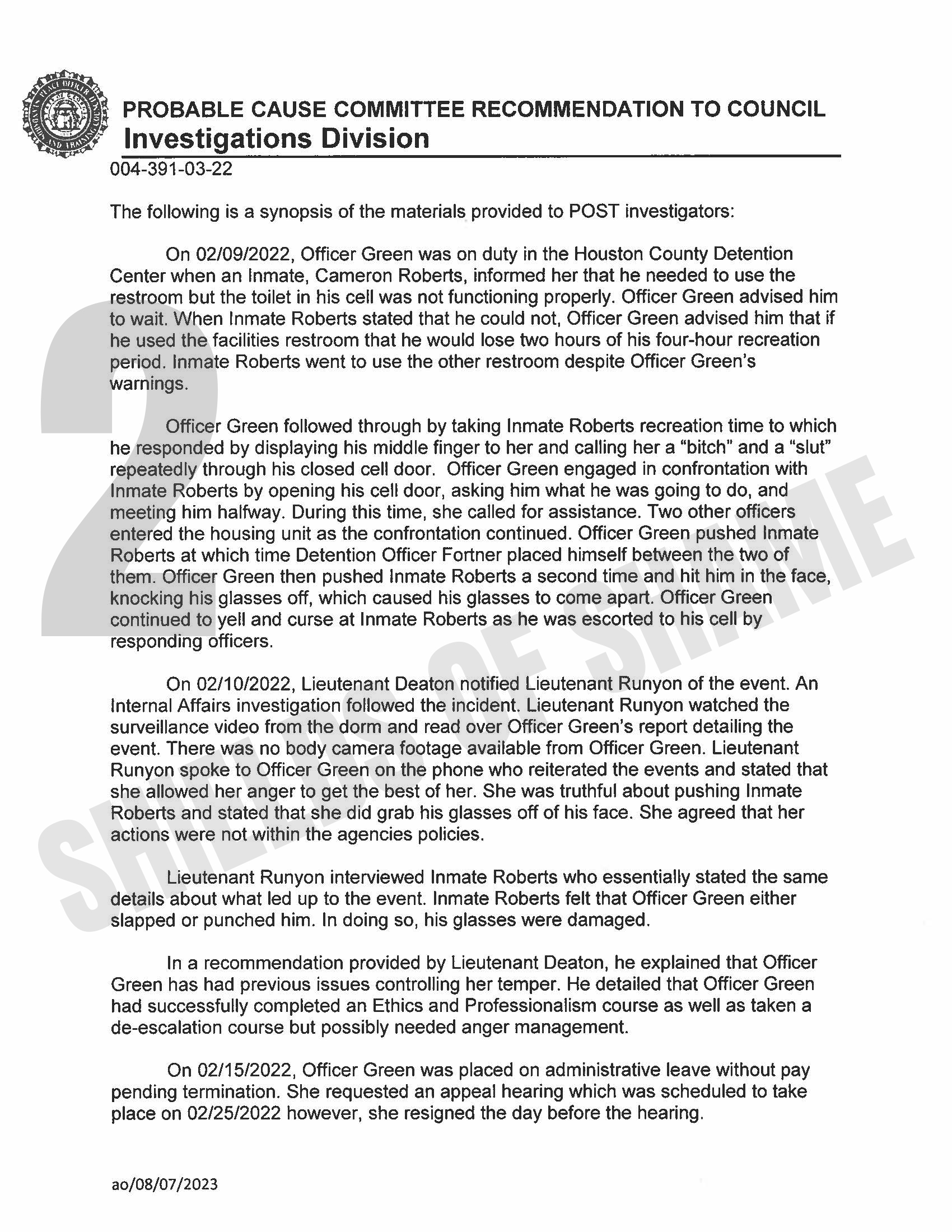
The state record says the confrontation began over something painfully ordinary: inmate Cameron Roberts needed to use a restroom because the toilet in his cell was not working properly.
Instead of ending with access to a functioning toilet and a routine disciplinary response, the dispute escalated. According to POST, then-detention officer Tanisha L. Green opened Roberts’ cell, asked what he was going to do, met him halfway and pushed him. Another detention officer stepped between them, yet Green allegedly pushed Roberts again and hit him in the face, knocking off and damaging his glasses.
Green later told an internal-affairs investigator that she had allowed her anger to get the best of her, the POST summary states. More than a year later, when a POST investigator asked whether she had taken any steps to address her anger issues, the record says she answered no and blamed the inmate’s deliberate provocation.
Georgia POST ultimately revoked both of Green’s state certifications.
What the records say happened
The February 9, 2022 incident occurred inside the Houston County Detention Center while Green was on duty.
According to the POST investigative synopsis, Roberts told Green that he needed to use the restroom but the toilet in his cell was not functioning properly. Green told him to wait. When he said he could not wait, she allegedly warned that using another restroom would cost him two hours of his four-hour recreation period.
Roberts used the other restroom anyway. Green then took away recreation time, the record says.
Roberts responded from behind his closed cell door by displaying his middle finger and repeatedly calling Green insulting names. His language may have been crude, but verbal abuse from a confined person does not by itself authorize retaliatory force.
The POST summary says Green opened the cell door, challenged Roberts and moved toward him while calling for assistance. Two other officers entered the housing unit. Green pushed Roberts, and detention officer Fortner placed himself between them. According to the state record, Green then pushed Roberts a second time and struck him in the face, causing his glasses to fall off and come apart. She continued yelling and cursing while responding officers escorted Roberts back to his cell.
The record does not identify Fortner’s first name, nor does it state that Fortner used improper force. It describes him as stepping between Green and Roberts.
No body-camera footage from Green
The internal investigation found no body-worn-camera footage from Green.
According to POST, Houston County investigators concluded that Green violated agency policies concerning:
- Activation of her body-worn camera during inmate contacts
- Excessive use of force
- Conduct unbecoming an officer
The dormitory surveillance system did capture the incident, according to the case summary. Lieutenant Runyon reviewed that surveillance video along with Green’s written incident report.
The missing body-camera recording is not a side issue. A camera policy is only as useful as compliance with it. When force is used inside a jail—where the government controls the environment, movement and most available evidence—an officer’s failure to activate a camera can deprive the public, supervisors and the confined person of the closest available account of what occurred.
Green’s admissions during the investigation
Lieutenant Runyon interviewed Green by telephone. According to POST, Green admitted pushing Roberts and said she grabbed the glasses from his face. The report says she acknowledged that her conduct did not comply with agency policy and stated that she allowed her anger to get the best of her.
Roberts separately told investigators that Green had either slapped or punched him and that his glasses were damaged.
This distinction matters: POST’s synopsis describes a strike to the face, while Green reportedly characterized part of the contact as grabbing the glasses. The underlying surveillance footage would be the strongest evidence for viewers to evaluate the precise contact themselves.
Supervisors had already documented temper concerns
The case did not appear against an empty disciplinary record.
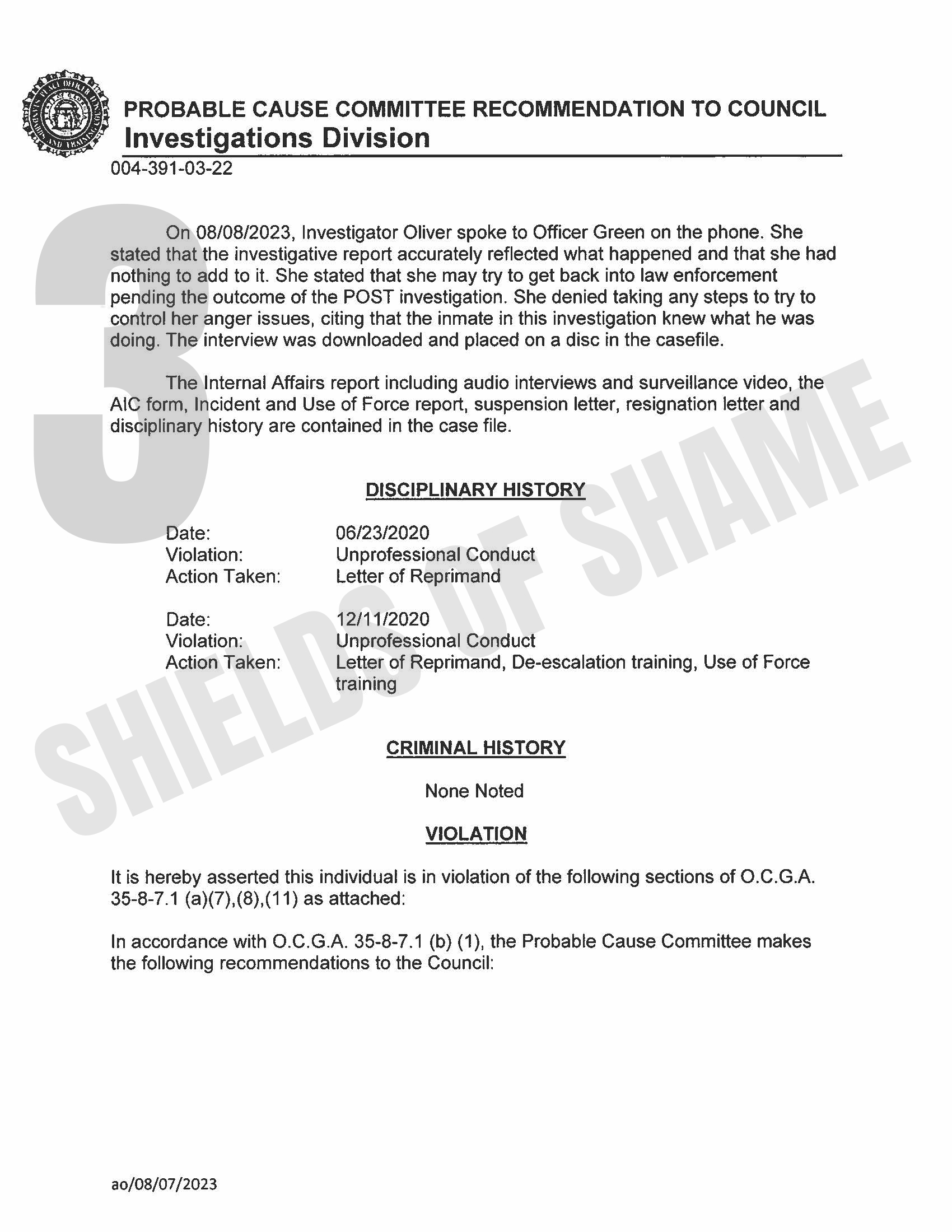
Lieutenant Deaton’s recommendation said Green had experienced previous problems controlling her temper. The POST file lists two earlier disciplinary actions:
| Date | Violation | Agency action |
|---|---|---|
| June 23, 2020 | Unprofessional conduct | Letter of reprimand |
| December 11, 2020 | Unprofessional conduct | Letter of reprimand; de-escalation training; use-of-force training |
The second reprimand is particularly relevant. Green had already been ordered to complete de-escalation and use-of-force training more than a year before the Roberts incident.
Her official training profile lists additional instruction in ethics, professionalism, de-escalation, crisis intervention and conflict resolution. By January 2022—only weeks before the confrontation—she had completed a four-hour conflict-resolution course.
Training existed on paper. The jail-floor conduct described by investigators tells a less reassuring story.
Suspension, resignation and POST investigation
Green was placed on unpaid administrative leave pending termination on February 15, 2022. She requested an appeal hearing scheduled for February 25 but resigned one day before the hearing, according to the POST summary.
Her state employment profile classifies the separation as “Resigned in Lieu of Termination.”
POST opened case 004-391-03-22 on March 15, 2022, citing possible cruelty to inmates, conduct unbecoming an officer and departmental-rule violations.
On August 8, 2023, a POST investigator interviewed Green. According to the state summary, Green said the investigative report accurately reflected what happened and that she had nothing to add. She also reportedly said she might try to return to law enforcement depending on the outcome of the certification case.
When asked about steps taken to control her anger, Green reportedly said she had taken none, explaining that Roberts knew what he was doing.
Provocation may explain anger. It does not excuse an officer opening a cell to continue a verbal dispute or using retaliatory force against someone in government custody.
Georgia POST revoked both certifications
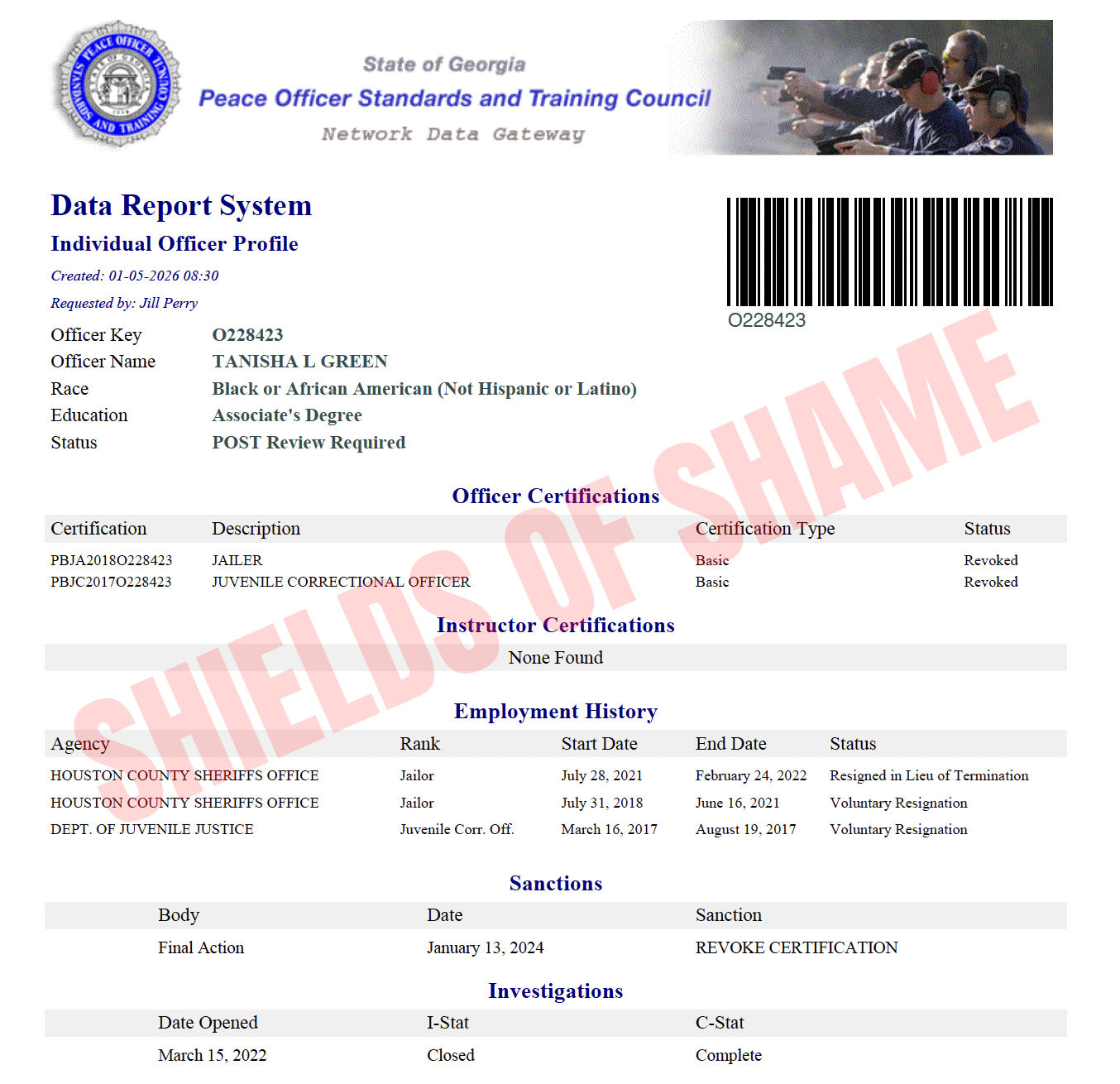
Green’s January 5, 2026 POST profile lists her status as “POST Review Required” and shows both of her basic certifications as revoked:
- Jailer certification PBJA2018O228423
- Juvenile correctional officer certification PBJC2017O228423
The profile records final action on January 13, 2024: REVOKE CERTIFICATION.
The probable-cause document alleges grounds under O.C.G.A. § 35-8-7.1(a)(7), (8) and (11). Those provisions address violating a law, rule or regulation related to officer practice; conduct indicating bad moral character or untrustworthiness; and suspension or discharge for disciplinary reasons. Georgia law authorizes POST to revoke a certificate after finding discipline is warranted. See the current text of O.C.G.A. § 35-8-7.1.
Under Georgia’s regulatory definition, revocation cancels an officer’s certification and means the person may no longer perform the functions of a certified officer. The Georgia POST Investigations Division explains that involuntary terminations, lengthy suspensions and alleged criminal involvement can lead to an investigation and recommendations including revocation, suspension or probation.
Employment history
Green’s state profile documents this employment history:
| Agency | Position | Dates | Separation |
|---|---|---|---|
| Georgia Department of Juvenile Justice | Juvenile correctional officer | March 16, 2017–August 19, 2017 | Voluntary resignation |
| Houston County Sheriff’s Office | Jailer | July 31, 2018–June 16, 2021 | Voluntary resignation |
| Houston County Sheriff’s Office | Jailer | July 28, 2021–February 24, 2022 | Resigned in lieu of termination |
The profile lists 535 total training hours across six years. It shows no firearms training apart from a single hour recorded in the summary table, while documenting training in jail operations, restraint devices, Taser use, report writing, first aid, suicide prevention, ethics, cultural awareness, de-escalation, crisis intervention and use of force.
What the available records do—and do not—establish
The POST recommendation lists “None Noted” under criminal history. Shields of Shame did not locate a reliable public report of Green being criminally charged over this incident, nor a clearly matching civil lawsuit in publicly indexed web results.
That does not prove no complaint, claim or non-indexed proceeding existed. It means the records reviewed for this article establish an administrative investigation and certification revocation—not a criminal conviction.
The source file says the underlying POST case contains the internal-affairs report, audio interviews, surveillance video, an incident report, a use-of-force report, Green’s suspension and resignation letters, and her disciplinary history. Those materials would provide important additional detail, particularly the surveillance footage and the complete body-camera policy in force on February 9, 2022.
The agency context
The Houston County Sheriff’s Office operates the detention center and publishes contact numbers for the jail, records division, criminal investigations and other services. Green’s incident occurred while longtime Sheriff H. Cullen Talton Jr. led the agency. Talton served for more than five decades and died in October 2024. Matt Moulton later became sheriff.
Current agency leadership should not be blamed for a 2022 personnel decision it did not make. Still, later events show that detention-officer oversight remains a live issue. In May 2026, local outlets reported that multiple Houston County detention employees were terminated after separate investigations involving alleged drug-related misconduct and alleged sexual contact with an inmate. Those later cases are unrelated to Green, but they underscore why hiring, supervision, camera compliance and early intervention inside the jail deserve sustained public scrutiny. See WGXA’s report on the 2026 terminations and 41NBC’s Operation Cellblock Syndicate coverage.
Questions Houston County should answer
The records leave several questions suitable for a follow-up Georgia Open Records Act request:
- What did the dormitory surveillance video show from beginning to end?
- Why was Green’s body-worn camera not activated, and was that failure detected before or only after the force complaint?
- What conduct produced Green’s two earlier unprofessional-conduct reprimands?
- What corrective supervision followed the 2020 temper, de-escalation and use-of-force concerns?
- Did Houston County refer the alleged strike to a prosecutor or outside investigative agency?
- Was Roberts reimbursed for his damaged glasses or provided replacement glasses?
- Were the supervisors’ intervention and early-warning procedures changed after the incident?
- How many detention employees have resigned in lieu of termination since 2020, and how many were reported promptly to POST?
Why this case matters
People in jail can be rude, provocative and difficult. That is neither surprising nor a blank check for punishment by force.
The power imbalance could hardly be greater: the officer has the keys, the uniform, backup, institutional credibility and control over the person’s movement. The confined person is behind a locked door and depends on the same institution for a working toilet, medical care and the preservation of evidence.
This case is not merely about an insult followed by a shove or strike. It is about what happens when warning signs, reprimands and training fail to change behavior—and when the camera that should document the encounter is not recording.
Georgia POST eventually imposed the strongest professional sanction available. But final action came nearly two years after the incident and almost two years after Green left the sheriff’s office. Accountability that arrives late still matters. It also raises the obvious question: what protects people in custody during the gap?
Sources and methodology
This article is based primarily on a four-page Georgia POST Probable Cause Committee case summary for case 004-391-03-22 and a three-page POST officer profile for Tanisha L. Green generated January 5, 2026. Shields of Shame compared those records with current Georgia law, official Georgia POST explanations, the official Houston County government website and related local reporting. Statements about the incident are attributed to the government records because Shields of Shame has not yet independently reviewed the underlying surveillance video or full internal-affairs file.
Related Shields of Shame coverage:
- Alisha Gibbs—revoked in Georgia for undue force
- Brittany Shakel Grier—detention officer misconduct investigation
- Stephen Justin Bartlett—Georgia POST records
Editorial note: This report concerns official administrative findings and allegations contained in government records. It does not claim that Green was criminally convicted. If Green or the Houston County Sheriff’s Office provides a substantive response or corrective documentation, Shields of Shame will review it and update the article where warranted.