SHIELDS OF SHAME | FREE PUBLIC POLICY LIBRARY
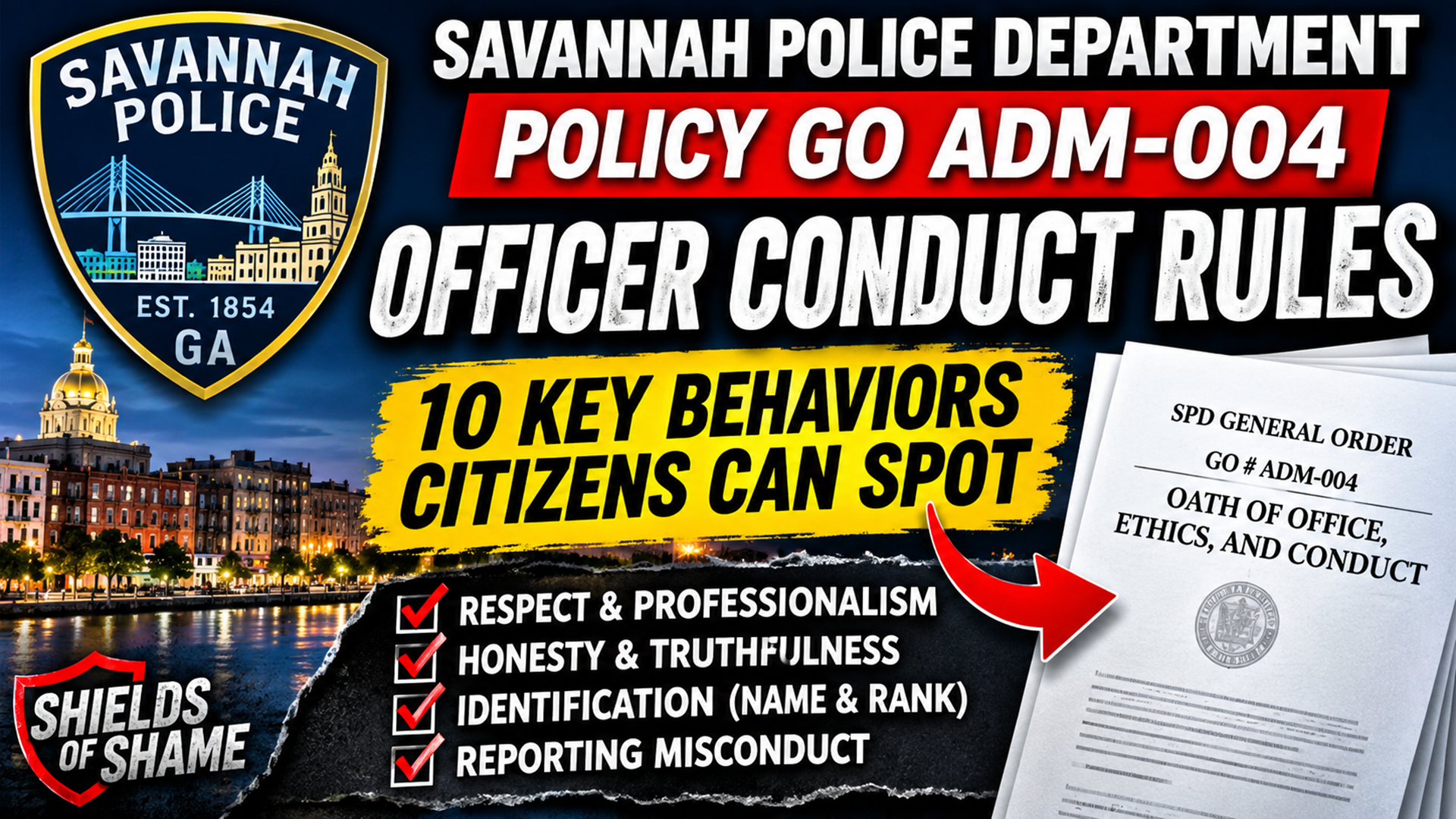
Savannah Police Department Rules: What Officers Are Required to Do
What does Savannah Police Department policy actually say about honesty, respect, discrimination, identification, reporting misconduct and the safety of people in custody? This citizen-friendly guide links directly to the source so you can check the language for yourself.
Document: SPD General Order GO ADM-004, Oath of Office, Ethics, and Conduct | 17 pages | Revisions listed through April 23, 2018. This copy has not been verified as the department’s current 2026 version.
VIEW OR DOWNLOAD THE ORIGINAL 17-PAGE POLICY (PDF)
10 Police Behaviors Citizens Can Recognize
These summaries are plain-language explanations, not quotations. Follow each page reference to verify the complete policy, including exceptions and context.
1. Respect and verbal harassment
Employees must treat citizens with respect and avoid offensive or harassing conduct, including vulgar language.
Find it: Pages 6–7, General Standards of Conduct, item 5
2. Truthfulness and honesty
Knowingly deceptive, misleading or false statements and material misrepresentations are prohibited.
Find it: Page 6, item 4
3. Discriminatory remarks
The order forbids disrespectful speech concerning nationality, race, sex or religion.
Find it: Page 6, item 5(b)
4. Officer identification
Officers must provide their name and/or rank and/or payroll number upon request, except for specified investigative or assignment-related exceptions.
Find it: Page 13, item Y
5. Limits on police authority
Officers are directed to understand the limitations on their legal authority and the rights of people they serve.
Find it: Pages 11–12, Professional Life Standards
6. Assistance and medical emergencies
Officers must respond to calls for assistance, subject to priority rules, and obtain medical care where required.
Find it: Page 12, items P–Q; page 14, item DD
7. Reporting violations
Employees with knowledge of specified misconduct must report it to a supervisor or the Office of Professional Standards.
Find it: Page 14, item CC
8. Retaliation for complaints
Retaliation for reporting, disclosing or assisting with an investigation of misconduct is prohibited.
Find it: Page 14, item CC(3)
9. False official records
Employees must not make false official reports or knowingly enter inaccurate or improper police information into records.
Find it: Page 15, item HH
10. Safety of arrested persons
Arresting officers are responsible for the safety and protection of people in custody, with transfer-of-custody provisions.
Find it: Page 13, item X
Other Important Rules in GO ADM-004
Officers cannot simply follow an unlawful order
Page 14 addresses unlawful orders and requires officers receiving an unlawful, unjust or improper order to report it through designated channels. It also explains the process for conflicting orders.
Supervisors have responsibilities too
Page 10 says commanders and supervisors must provide meaningful direction and must not overlook or condone incompetence or misconduct. Page 14 also addresses supervisors’ obligations to report known violations.
Gifts, favors and conflicts
Pages 9 and 15 address gifts, gratuities, improper recommendations, outside associations and personal benefit connected to police duties.
Discipline is possible, but not automatic
Pages 15–17 describe disciplinary authority and possible sanctions. A complaint or apparent policy conflict does not by itself prove a violation or guarantee discipline.
How to Document a Possible Policy Violation
- Write down the date, time, precise location and officer identifiers.
- Preserve original video, photographs, messages, witness names and incident numbers.
- Record the exact conduct, not just a conclusion such as “unprofessional.”
- Match what happened to the relevant policy page and section.
- Request incident reports, body-camera footage, dispatch/CAD records and applicable policies through appropriate Georgia open-records procedures. Some records may be exempt or restricted.
- When making a complaint, request a tracking number and retain a copy of your submission.
Important: Do not interfere with an active police operation. Policy requirements are separate from criminal statutes and constitutional standards. The applicable policy may have changed after the date of this document.
Frequently Asked Questions
Can a Savannah police officer be rude or insulting?
GO ADM-004 instructs employees to treat citizens respectfully and prohibits specified offensive, harassing and vulgar conduct. See pages 6–7.
Does an SPD officer have to identify themselves?
Page 13 contains an identification requirement, with exceptions for certain investigative or assignment circumstances. Read the full section before asserting a violation.
Can an officer retaliate after a misconduct complaint?
The supplied order prohibits retaliation for reporting misconduct or assisting with an investigation. See page 14.
Is this Savannah Police Department’s current policy?
Not verified. The provided document lists revisions through April 23, 2018. Request the latest effective version directly from SPD before using it to assess a newer incident.
Where can I read the complete policy?
Read SPD GO ADM-004 in full (PDF). This public reference is free to access.
Source and Editorial Note
Source: Savannah Police Department, General Order GO ADM-004 (17-page PDF). This guide is independent journalism by Shields of Shame, not an official SPD publication or legal advice. The policy summaries are educational; the original document controls in the event of any difference in wording.