
SHIELDS OF SHAME | GEORGIA ACCOUNTABILITY INVESTIGATION
He Had the Blue Lights. He Had a Government Vehicle. But He Wasn’t a Police Officer.
Former Richmond County jail officer Ronald L. O’Brien made unauthorized traffic stops while employed by the City of Keysville. State records show a guilty plea under the First Offender Act and the eventual revocation of his jailer certification.

The blue lights that raised the alarm
Imagine driving through a small Georgia town and seeing blue emergency lights flash behind you. The vehicle belongs to the local government. The person behind the wheel appears to have official authority. You pull over. But what if the person stopping you has no authority to enforce traffic laws?
That was the central concern in Keysville, Georgia, in October 2022. According to the Burke County Sheriff’s Office investigation, Ronald Lee O’Brien, then employed as a municipal code enforcement officer, was using vehicles equipped with blue lights to stop pedestrians and motorists. Local news reports identified one of the vehicles as city-owned. The sheriff’s office urged anyone stopped by O’Brien to contact investigators.
O’Brien was no stranger to government employment. Georgia POST records show he worked as a jail officer for the Richmond County Sheriff’s Office from July 25, 2009, until his voluntary resignation on July 14, 2011. But serving as a jailer is not the same as being certified to make traffic stops. The POST investigation expressly states that he never held a Georgia Basic Peace Officer certification.
What investigators found
The POST investigative narrative says Burke County deputies went to O’Brien’s residence and found a municipal vehicle equipped with emergency lights. City administrators told investigators they had not authorized the installation. Investigators later searched another vehicle and found assorted law enforcement related items. Witnesses described encounters in which O’Brien had stopped them and presented himself as a law enforcement officer.
According to the investigation, O’Brien told deputies he was retired from the VA Police and repeatedly asserted that his federal credentials had transferred to Georgia POST. Those statements are documented as his claims, not independently established credentials. Investigators reported that Keysville officials had not conducted a thorough background investigation and that his code enforcement job did not require law enforcement duties.
The court case and guilty plea
O’Brien was arrested October 3, 2022, and charged with felony impersonating a public officer. The supplied court docket identifies case 2022R0185 and the offense under O.C.G.A. § 16-10-23. It records a December 15, 2022 indictment and subsequent proceedings. On March 11, 2024, the POST case summary says O’Brien pleaded guilty in a negotiated disposition and received one year of probation under Georgia’s First Offender Act. The docket labels the disposition FIRST OFFENDER STATUS.
Legal distinction: A guilty plea handled under Georgia’s First Offender Act should not automatically be described as an ordinary final conviction. The supplied records do not establish whether first offender supervision was successfully completed or later revoked.
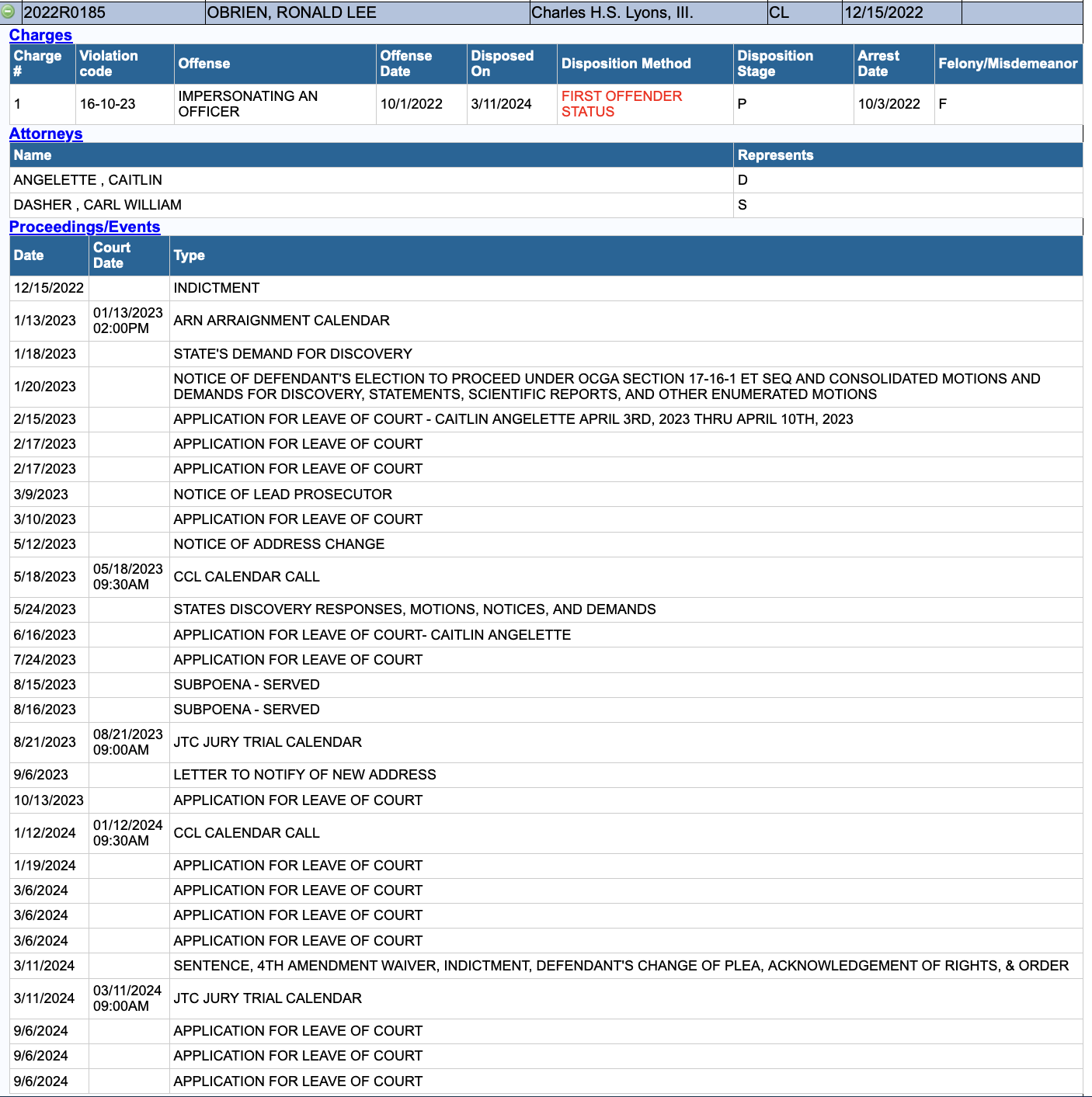
Supplied court docket screenshot. Open the image in a new tab for details.
POST revokes his certification
On July 25, 2025, Georgia POST took final action revoking O’Brien’s Basic Jailer certification. His September 28, 2026 POST profile confirms the revoked status and records 125 total training hours across the listed years. It identifies his Richmond County Sheriff’s Office service, but no Georgia Basic Peace Officer certification. The revoked credential was a jailer certification, not a peace officer certification.
A public trust problem beyond one employee
Code enforcement can address municipal issues such as unsafe properties, dumping and nuisance conditions. It does not, merely by virtue of the job title, give an employee authority to conduct police traffic stops. This case raises questions for the City of Keysville: Who controlled the city vehicle? How were emergency lights installed without approval? What checks were conducted before hiring? How many residents were stopped, and what records exist of those encounters?
The investigative record documents administrators’ statements about the lack of authorization and background review. It does not establish that those administrators knowingly approved the stops or participated in the misconduct. Those are separate questions that require evidence.
Case timeline
- July 2009 to July 2011: Richmond County Sheriff’s Office jail employment.
- October 3, 2022: Burke County arrest following complaints of impersonation.
- December 15, 2022: Court docket records indictment.
- March 11, 2024: Guilty plea and First Offender disposition, with one year probation reported by POST.
- July 25, 2025: POST revokes Basic Jailer certification.
- September 28, 2026: POST profile generated showing revoked certification.
Examine the primary records
Investigator narrative, witnesses, arrest and dispositionPOST certification and training record ↗
Employment, courses and revocationCriminal court docket ↗
Indictment, proceedings and First Offender entry
Independent reporting and legal context
WRDW/WAGT: Keysville arrest report ↗
Atlanta News First: Unauthorized traffic stops ↗
Georgia statute on impersonating a public officer ↗
Why Shields of Shame publishes these records
Police authority is not a costume, a flashing light or a government vehicle. It comes with legal limits, certification requirements and public accountability. Shields of Shame examines the documents behind the headlines so readers can distinguish allegations, official findings and court outcomes.
Support independent investigative reporting and access the Shields of Shame Vault for additional records and case archives. Your membership helps keep public investigations like this one accessible.
Editorial note: This report distinguishes investigative allegations, reported witness accounts, court records and final POST administrative action. The First Offender disposition is not presented as proof of a final conviction. No additional criminal offenses or victims are asserted beyond the available evidence. Published October 2026.