SHIELDS OF SHAME • ATLANTA POLICE ACCOUNTABILITY
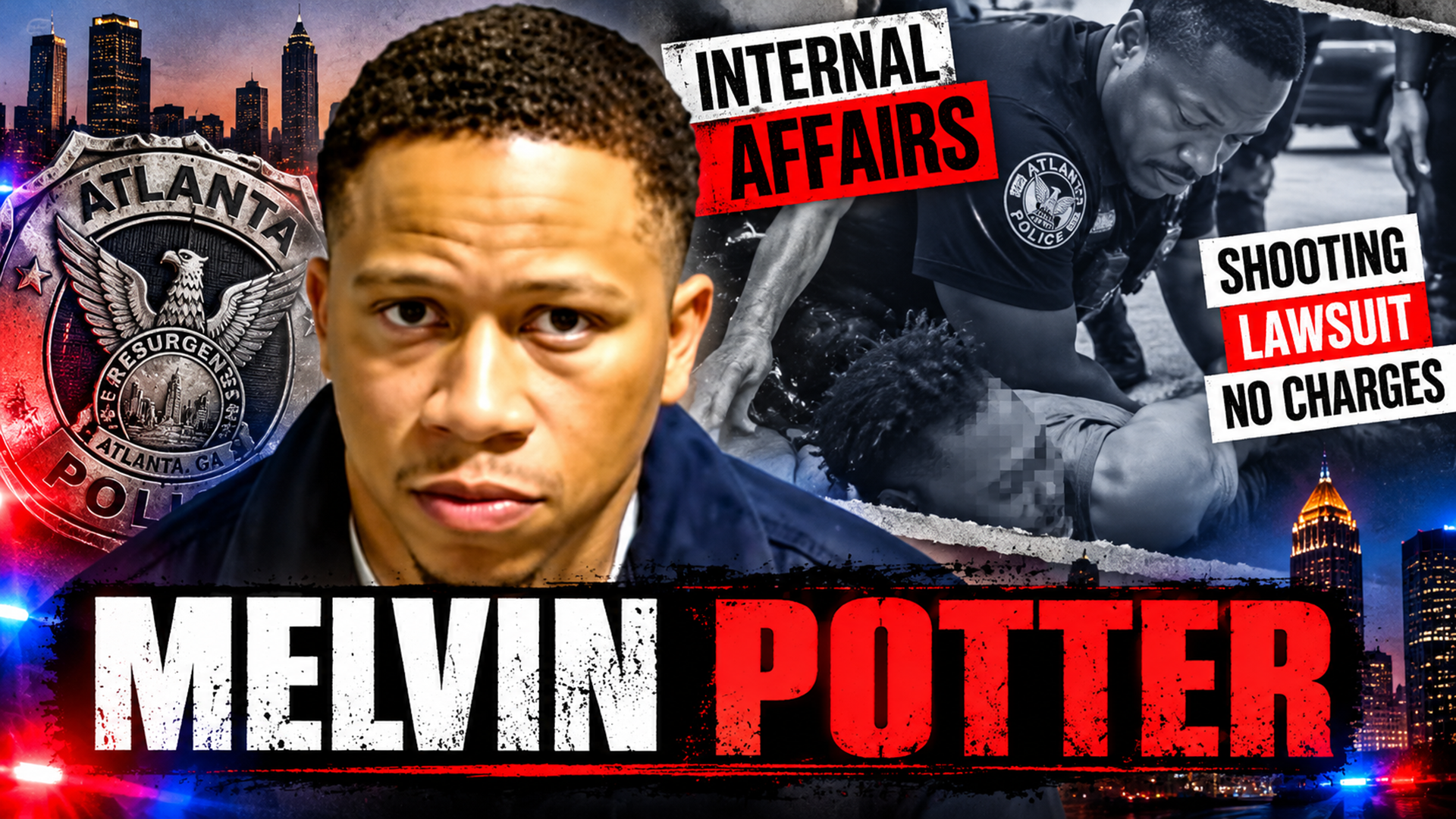
Melvin Potter: The Internal Affairs File, Conflicting Testimony, and the Cases That Followed
Updated October 2026. What began as a disputed confrontation between two Atlanta Police Department officers in 2017 led to an internal affairs file filled with conflicting statements, injury photographs and contested investigative techniques. Years later, Potter’s disciplinary history became part of a much larger public controversy after he fatally shot Devon Anderson while off duty.

Important distinctions: APD found the 2017 misconduct allegations not sustained. In July 2026, prosecutors separately concluded Potter’s 2024 shooting was justified under Georgia self-defense law and declined criminal charges. The Anderson family’s federal civil lawsuit is a different proceeding and does not become resolved by the criminal charging decision.
2017: Two officers, two incompatible accounts
Melvin Potter and fellow APD officer Iscah Njoku had been romantically involved. On September 3, 2017, Njoku arrived at Potter’s apartment intending, she said, to discuss her pregnancy. Potter said he did not welcome the visit, that she entered behind him and repeatedly refused to leave. Njoku acknowledged refusing to leave, but disputed his characterization of how she entered.
What followed was a physical struggle. Njoku alleged Potter ripped her shirt, lifted her and threw her outside, causing injuries. Potter denied carrying or throwing her, telling investigators he took her wrists to escort her out and that she tried to force her way back through the closing door. He attributed possible injuries to the door struggle or a fall. Both agreed her shirt tore and that she was left outside exposed; Potter said he arranged for a replacement T-shirt.

The witnesses and injury evidence
Potter’s roommate Marcel Hutcherson supported substantial parts of his version, including the requests that Njoku leave and the struggle at the doorway. Investigators recognized that his friendship and living arrangement with Potter limited his independence. Other witnesses, including Shanquisha Murray and Che Milton, provided information but were not direct observers of the central confrontation. Injury photographs documented physical marks, but the parties disagreed about their cause.
Separate allegations involving her neck
Njoku also alleged that Potter later touched or placed his hands around her neck and pushed her against a wall during separate encounters. Potter denied these allegations. The file did not establish the contested events through an independent eyewitness. These remain allegations, not sustained findings.
The voice-stress examination
APD administered Computer Voice Stress Analyzer examinations. Potter’s denial that he carried Njoku from his apartment was reportedly marked “deception indicated”; his denial of putting his hands around her neck was marked “no deception indicated.” Njoku’s answers on the doorway and neck questions were reportedly marked “no deception indicated.” These results do not establish truth or guilt: voice-stress methods have significant reliability limitations and should not be treated as definitive proof. The final APD decision did not rest on the results alone.
The official 2018 disposition
Following interviews and examination of the available evidence, the Office of Professional Standards concluded there was insufficient evidence to prove the alleged work-rule violation. The Potter allegation was Not Sustained, and the Njoku matter was listed as Exceptionally Closed. Neither disposition establishes that every allegation was false. Conversely, the existence of photographs, contradictory accounts or a flagged stress-analysis answer does not establish that Potter committed an assault.
Later disciplinary history
The original SOS archive includes multiple other IA and use-of-force files, including a June 2023 encounter involving Dcoris Toland. Those matters must be evaluated separately, on their own evidence and findings. Reporting by the Atlanta Journal-Constitution described at least eight internal investigations involving Potter since he joined APD in 2015, along with a 2021 DUI arrest and an April 2022 conviction that led to three years of Georgia POST administrative probation.
August 5, 2024: Devon Anderson fatally shot
According to the Georgia Bureau of Investigation, off-duty Potter became involved in an argument near a bar on Old National Highway in College Park and shot 38-year-old Devon Anderson, who died. Potter was separately arrested on an obstruction allegation after the shooting. The shooting became the subject of intense public scrutiny and a federal lawsuit brought by Anderson’s mother. The family’s allegations and the official investigation differ materially about the circumstances of the shooting.
Major update: prosecutors decline charges in 2026
In July 2026, reporting confirmed that the Fulton County District Attorney’s Office would not seek an indictment. Prosecutors said their investigation and the GBI investigation supported a justified claim of self-defense. The family’s account disputed that conclusion, and the family continued to seek accountability. APD said Potter remained employed on administrative duty; its separate internal investigation was reported as ongoing at that time. No newer administrative disposition is confirmed here.
Federal civil litigation
Anderson v. City of Atlanta et al., No. 1:25-cv-06031, was filed in the Northern District of Georgia in October 2025. The public docket reflects motions and litigation activity in 2026. A refusal to bring criminal charges does not automatically end civil litigation. Readers can follow the docket for developments rather than assume a verdict or settlement.
Original records — document library
Read the evidence yourself. These archived PDFs are currently hosted on the original Shields of Shame domain; each opens in a separate tab.
Related reporting, court records and SOS investigations
What remains unanswered?
What did APD ultimately determine in its post-shooting administrative investigation? What records explain how the agency assessed Potter’s disciplinary history when deciding his assignments? And how will the Anderson family’s federal claims proceed? These are questions for records, sworn testimony and judicial findings—not speculation.
Editorial standards: Shields of Shame publishes records and attributed reporting in the public interest. Allegations, administrative findings, criminal charging decisions and civil claims are separate categories of evidence. Individuals are not presumed guilty merely because they appear in an internal affairs file. This page will be updated when additional verified records become available.