SHIELDS OF SHAME • GEORGIA FLOCK INVESTIGATION
Heidi Ann Taylor: 1,200 Alleged Flock Searches and the Questions Dallas Police Must Answer
A decorated former 911 director. Two people allegedly monitored. Hundreds of searches. And an investigation launched after a journalist’s inquiry.
Case status: Arrested and charged August 12, 2026. Two misdemeanor counts reported. These are allegations, not a conviction.
What investigators confirmed
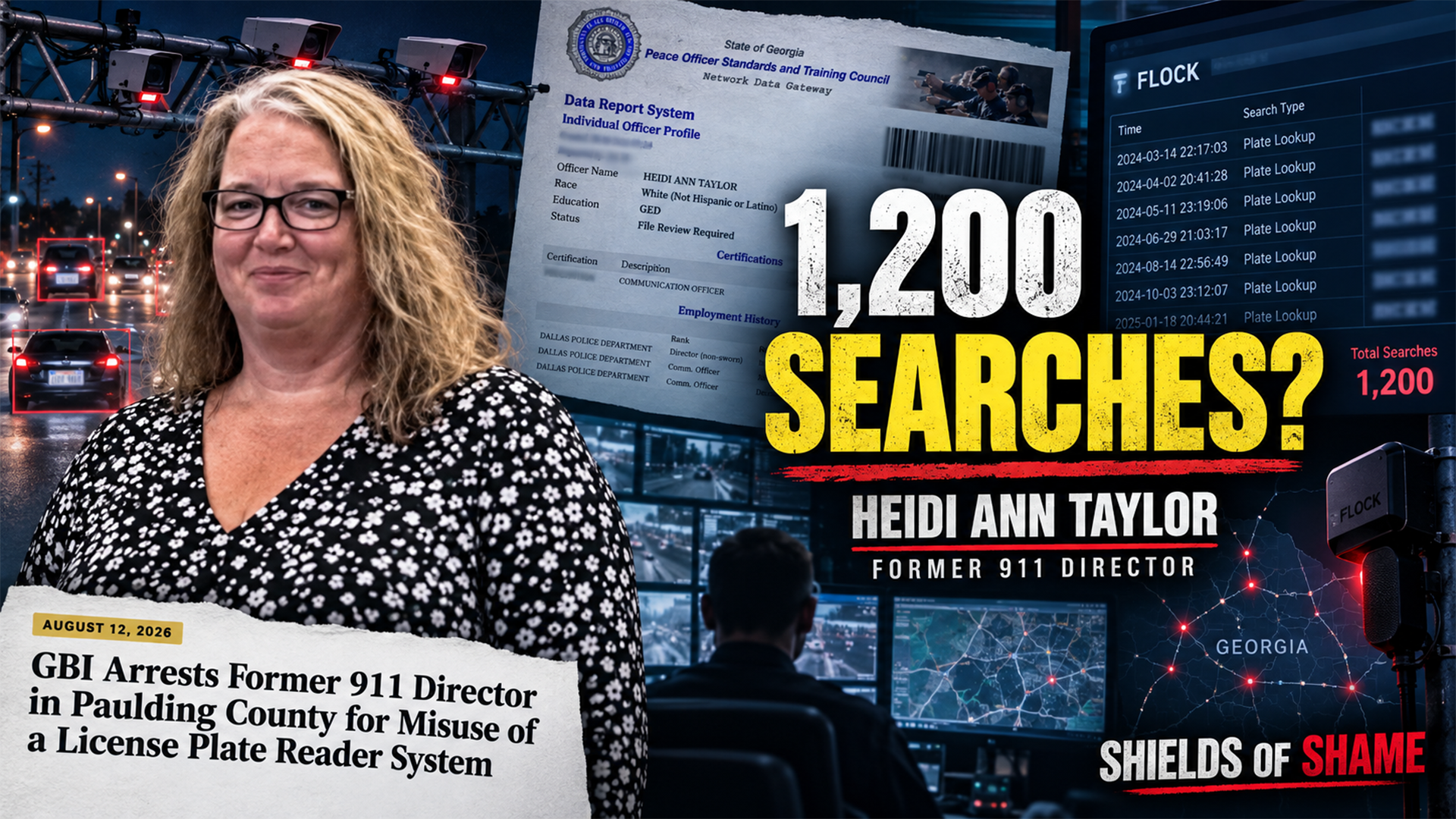
On August 12, 2026, the Georgia Bureau of Investigation announced that former Dallas Police Department 911 director Heidi Ann Taylor, 52, had been arrested and charged with two misdemeanor counts of misuse of a license plate reader system. The GBI said preliminary evidence indicated non-law-enforcement access to the department’s Flock Safety system during 2024 and 2025. Dallas Police requested the investigation on July 7, 2026. The GBI said its investigation was ongoing at the time of its announcement.
Read the official GBI announcement ↗
What USA TODAY found in the search records
USA TODAY reported that Taylor queried license plates associated with her estranged husband, Billy Wayne Taylor, and his girlfriend, Leandra Higgenbottom, approximately 1,200 times. Its analysis described nearly daily activity between July 2024 and May 2025, including as many as 39 searches in a single day, some seconds apart. More than half of the searches reportedly occurred between 7 p.m. and 3 a.m.
Billy Taylor told the publication the couple separated around November 2024 after 27 years together. Both he and Higgenbottom alleged that Heidi Taylor appeared unexpectedly at restaurants, Higgenbottom’s workplace, and an Alabama property they visited. These are their accounts; the reported searches and encounters should not be treated as judicial findings.
According to Billy Taylor’s account, after the arrest he asked Heidi why she had tracked them and she replied, “You know why.” That is a reported quotation, not a verified recording or admission in court.
Read the USA TODAY investigation (syndicated) ↗
The timeline that demands an explanation
July 2024–May 2025: Period of repeated license plate searches reported by USA TODAY.
May 15, 2026: Taylor’s Georgia POST employment record, reproduced in the original SOS investigation, indicates a transfer from the director position to another civilian position; the precise circumstances remain unclear.
July 6, 2026: USA TODAY reportedly contacted Dallas Police about the Flock activity.
July 7, 2026: Dallas Police requested a GBI investigation.
August 10, 2026: A POST investigation date appears in the original SOS record.
August 12, 2026: GBI announced Taylor’s arrest.
August 20, 2026: The original SOS report describes a restraining-order petition filed by Higgenbottom; its ultimate disposition has not been independently established here.
The one-day gap between the news inquiry and the GBI referral is significant, but it does not by itself prove that the department had never noticed suspicious activity. Records of earlier internal reviews, audit alerts, and supervisory notifications are needed to answer that question.
From award-winning director to criminal defendant
The original SOS investigation documents Taylor’s long communications career: service as a communications officer from December 1998 to September 2000 and again from January 2011 to July 2016, followed by a non-sworn director role beginning in July 2016. In September 2023, the Dallas Police Department reportedly recognized Taylor’s Public Safety Award from the Paulding County Chamber of Commerce and identified her as a GCIC terminal agency coordinator (TAC).
That background matters because a terminal agency coordinator works in an environment governed by criminal justice information security rules. Taylor’s reported training included GCIC operations, CJIS security, criminal history systems, cybersecurity and supervisory responsibilities. The issue is not simply who can use Flock: it is who reviews the people who can use it.
What her POST records show—and do not show
The POST profile examined in the original SOS article listed Taylor’s basic communications-officer certification as active, with an overall “File Review Required” notation. A September 16, 2026 snapshot reportedly showed an investigation assigned but no formal sanction listed. These are historical snapshot details, not a verified current certification determination. A new POST record is necessary to establish whether that status has changed.
The same employment history lists a May 15, 2026 transfer to a civilian position within the agency, even though her director position was already non-sworn. The record alone does not establish whether she resigned, was terminated, retained database access, or moved for reasons connected to the allegations.
Why only two charges?
The GBI announced two misdemeanor counts, although USA TODAY described approximately 1,200 searches. It is not yet established whether each charge corresponds to one person, one incident, a group of searches, or some other charging theory. Arrest warrants, charging documents, and court dockets—not assumptions—are needed to resolve this discrepancy.
The records that can expose a Flock oversight failure
For this investigation, the most valuable documents are the Flock search audit export (including operator, date/time, query reason, case number, searched plate where lawfully releasable, and search history), user permission and account-change logs, supervisor audit reports, alert histories, and records showing when Taylor’s credentials were disabled. Additional requests should seek the department’s ALPR policies, training acknowledgments, internal complaint and referral records, correspondence with Flock Safety, and the GBI investigative file when legally releasable.
Request nonexempt administrative logs with sensitive plate information redacted where necessary; Georgia law restricts disclosure of captured ALPR data, so the availability of each category must be assessed separately. Ask the agency to cite a specific exemption for any withheld record, identify segregable nonexempt material, and preserve the underlying audit logs.
Source documents and further reporting
The accountability question
How can a sensitive police surveillance system reportedly be queried hundreds of times for the same privately connected individuals without an earlier intervention? If the records support the reported pattern, Dallas Police should explain its supervisory audits, automated flags, user access controls, and timeline of discovery. The department’s internal knowledge and response cannot be determined from the publicly reported arrest alone.
Surveillance accountability requires more than documenting improper searches after someone is arrested. It requires controls capable of detecting and stopping misuse while it is happening.
Editorial note: Updated research through October 10, 2026. Taylor is presumed innocent unless proven guilty. The approximately 1,200-search figure is attributed to USA TODAY, not to the GBI charging announcement. No later conviction, dismissal, or final POST action has been verified for this update.