SHIELDS OF SHAME | DOCUMENTED INVESTIGATION | UPDATED OCTOBER 8, 2026
Dominic Lamont Freeman: Cherokee County Internal Affairs, Speeding Complaint, Resignation and Georgia POST Certification
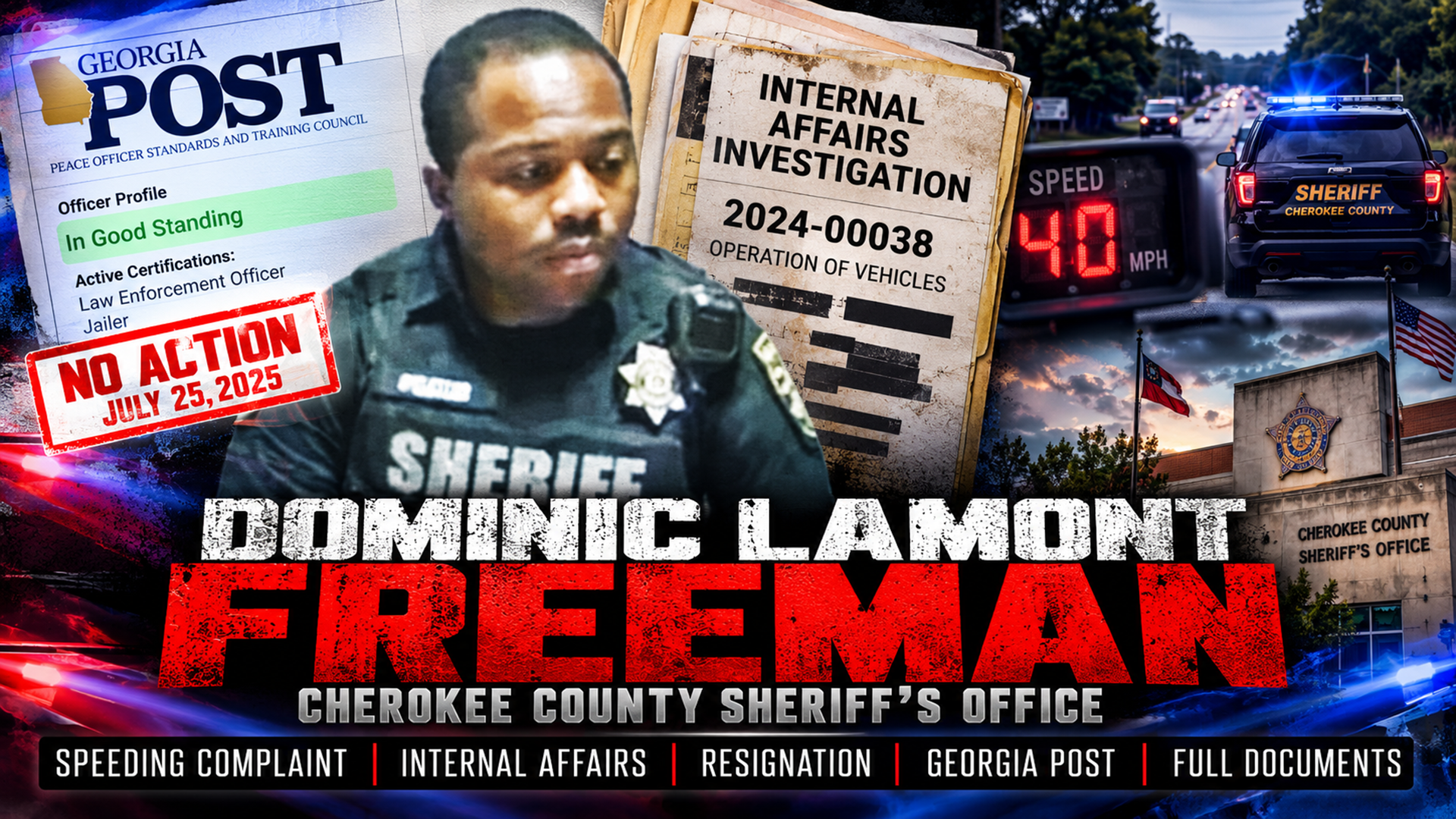
At a glance: A citizen’s complaint about patrol vehicle 1060 led to an internal investigation into speeding on Sixes Road. Separate later investigations found sustained violations relating to reporting, performance, honesty and equipment. Freeman resigned December 3, 2024 while under investigation. Georgia POST opened a certification case January 13, 2025 and recorded a final action of NO ACTION on July 25, 2025. His October 8, 2026 POST profile shows In Good Standing and active Basic Law Enforcement and Jailer certifications.
Important distinction: The 2024 speeding complaint is distinct from the three later internal investigations addressed in the 2025 POST case. Findings are attributed to their respective records. Freeman contested aspects of the later allegations. A POST no-action decision is not a court determination that every disputed event was proper.
Key documented dates
2024: Citizen Shane reports alleged speeding by unit 1060; internal affairs file 2024-00038 documents the investigation.
December 3, 2024: Freeman resigns while under investigation.
December 19, 2024: Lieutenant Barone reports the resignation to POST.
January 13, 2025: POST investigation opens.
January 31 and February 7, 2025: Freeman speaks with POST and provides a written response.
July 25, 2025: POST final action: NO ACTION.
October 8, 2026: POST profile lists certifications active and status In Good Standing.
Chapter 1 | The citizen who called himself Shane
Shane described attempting to enter Sixes Road near the mountain bike park when a Cherokee County Sheriff’s Office vehicle, identified as unit 1060, passed at what he believed was excessive speed. He contacted Lieutenant David Barone to ask how such a complaint would be investigated, whether dispatch records would confirm an emergency response and whether vehicle GPS information existed.
During the conversation, Barone discussed possible emergency-call explanations, the distinction between officer discretion and speed-enforcement thresholds, and the availability of records. Shane requested a formal complaint address and said he possessed dash-camera footage. The exchange is the opening chapter of this investigation.
Watch Chapter 1: Shane’s Call ↗Read Clean Call Transcript ↗
The transcript is a cleaned working transcript; consult the recording for precise wording and speaker attribution.
Internal Affairs | Vehicle speed and Lieutenant Barone’s interview
The internal affairs investigation reviewed patrol-vehicle location information and dispatch context. The investigation documented Freeman traveling above the posted 40 mph speed limit and sustained the speeding allegation. In his interview, Freeman said he did not recall speeding, then acknowledged the documented speed information and apologized. The primary report should be consulted for the precise chronology, measurements, interviews and disposition.
Why the evidence matters: The original telephone conversation raised the issue of what records could establish vehicle speed. The subsequent investigative documentation makes the underlying records central rather than leaving the matter as one person’s recollection against another’s.
Three later investigations | Reporting, victim protection and equipment
Georgia POST’s investigative summary says Freeman was placed on a performance improvement plan because of recurring reporting failures, incomplete reports and omissions of critical information. It describes three internal investigations, each recommending termination, with sustained findings involving dereliction of duty, incompetence, honesty and violations of established policy and procedure.
The 74-year-old complainant
POST’s summary describes a 74-year-old woman reporting that a plumber exposed himself. Investigators reportedly reviewed body-camera footage and found Freeman had not prepared an incident report or notified CID or Adult Protective Services. This is a finding reported by POST’s investigator, not an independent criminal conviction of Freeman or the plumber.
The performance improvement plan
The summary says repeated report errors and omitted information continued despite additional instruction. Captain Shinall concluded Freeman had been given ample opportunity to improve but remained below the expected standard for Field Operations.
The issued shotgun
According to the POST investigator, Freeman told a supervisor the shotgun had been turned in, but the weapon was subsequently found in his patrol vehicle beneath equipment. The investigator also reported Freeman had not qualified with that shotgun since calendar year 2021.
Outcome: Freeman resigned before the recommended employment termination could be implemented. This was a resignation while under investigation, not a recorded firing.
Freeman’s response | His side of the allegations
In his February 7, 2025 written response, Freeman disputed aspects of the internal investigations. Regarding the elderly woman’s complaint, he described a different initial account of the plumber incident, said he informed Sergeant Hite, and said Corporal Murphey later offered to handle the report. He challenged the scrutiny of his report writing and described prior praise for his work. Regarding the shotgun, he said he intended to turn it in but forgot during a family emergency and maintained he had been truthful about its location.
Freeman also described concerns about supervision, a disputed citation and an allegation that he used artificial intelligence in an application essay, which he said was unfounded. These statements are Freeman’s account; the POST investigative summary reached different conclusions on material issues.
NEW DOCUMENT DEEP DIVE • INTERNAL AFFAIRS 2024-00008
Chapter: Accused of Using AI to Write an Investigator Application — But the Honesty Charge Was Not Sustained
The bottom line: Cherokee County Sheriff’s Office investigated Deputy Dominic Freeman over an essay submitted for a Criminal Investigations Division investigator opening. Supervisors suspected he had used artificial intelligence and had been untruthful when questioned. Freeman repeatedly denied using AI, acknowledged assistance editing drafts, and underwent a polygraph examination. After examining the essay, software reports, interviews and other records, the agency’s February 9, 2024 final report classified the honesty allegation as NOT SUSTAINED because investigators lacked sufficient evidence to prove or disprove it. This is a separate case from the later speeding investigation and from the internal investigations cited in the Georgia POST certification case.
READ THE COMPLETE INTERNAL AFFAIRS FILE — CASE 2024-00008 (PDF) ↗
How a job application became an internal affairs investigation
In January 2024, Freeman applied for a lateral move into the Sheriff’s Office Criminal Investigations Division. Applicants were instructed to submit an approximately 1,000-word essay demonstrating analytical thinking, critical reasoning and writing skills. Freeman wrote about a prior missing-juvenile investigation that, according to his essay, grew into a larger criminal investigation involving suspected exploitation and drug activity. Those assertions appear in his application essay and should not be treated as independently verified findings about the underlying criminal case.
The CID selection board interviewed candidates on January 26. A supervisor noticed a difference between Freeman’s essay and the style of his earlier reports and writing samples. Captain L.A. Hands documented comparisons using several AI-content detection services, including Copyleaks, GPTZero and Sapling. The reports did not agree: some initial tests flagged substantial AI-like content, while other comparisons and later scans identified human-written content. Supervisors also reviewed Freeman’s older application essays and incident reports, which they considered more consistent with his usual writing.
What Freeman told the selection board
Board members said applicants were asked whether they had used AI in preparing their essays. According to memoranda from Sergeant Daniel Hayes, Sergeant Jason Yarbrough and Sergeant S. Prescott, Freeman was questioned again after his interview. He denied using AI and said he had used Grammarly. In subsequent interviews, Freeman maintained he wrote the essay himself, worked through multiple drafts, and received editorial help from his wife and Corporal Garland. The distinction matters: getting another person to review wording and grammar is not the same factual allegation as having an AI system generate an essay.
Texts, drafts and the Corporal Garland interview
Investigators collected draft versions of the essay and communications concerning edits. The file includes screenshots of text exchanges and multiple versions of the essay. Corporal Garland confirmed helping Freeman edit the work, including changes to wording, clarity and grammar, but did not say that he had written it for Freeman. Garland said he did not believe Freeman had used AI and described the pressure Freeman felt to explain himself. The investigative file contains the supporting materials so readers can compare the competing interpretations rather than rely on a single software percentage.
Administrative leave and the polygraph
On February 5, 2024, Freeman received written notice of an internal affairs investigation and was placed on paid administrative leave pending the results. He underwent a polygraph examination administered by Daniel Sosnowski on February 3, 2024. The examiner reported physiological responses he considered indicative of deception on questions asking whether Freeman used AI or other software beyond Grammarly to modify, reword or rephrase the essay. That is the examiner’s interpretation of physiological responses, not proof that AI was used. Freeman maintained his denial and said he believed he had answered honestly.
Why the AI-detector numbers were not conclusive
Captain Kim Thompson’s final report explicitly addressed the limitations of both methods used against Freeman. AI-content detectors can produce false positives, their results varied among services and tests, and a polygraph reaction does not by itself establish that a particular statement is false. The final investigator stated that the agency could not determine with certainty whether AI was used in the essay. This is especially significant because some pages in the file show starkly different software results on essay versions and repeated scans.
The official outcome: NOT SUSTAINED
In the February 9, 2024 final report to Lieutenant Colonel W. J. Smith, Captain Thompson concluded that the evidence was insufficient to prove or disprove a violation of the Sheriff’s Office honesty policy. The allegation was classified NOT SUSTAINED. That does not mean investigators affirmatively proved Freeman never used AI; equally, it would be inaccurate to call the allegation sustained or say the agency established that he lied. The agency’s documented conclusion is narrower: it could not prove the allegation.
Guide to the lengthy records package
Pages 1–3: Final investigative report and conclusion. Pages 4–11: Internal affairs narrative, interviews, policy analysis and final not-sustained rationale. Page 12: Paid administrative leave memorandum. Pages 13–15: Allegation and disposition forms. Pages 16–25: Supervisory memoranda, CID selection-board statements and early AI-detector comparisons. Pages 26–29 and 37–40: Versions of Freeman’s application essay. Pages 30–36: Polygraph examiner’s report, questions, results and consent paperwork. Pages 41–49: Copyleaks reports and comparison material. Pages 50 onward: Additional screenshots, text communications, drafts and exhibits; these should be read in context, particularly where material is redacted or excerpted.
Why this case belongs in the larger Freeman investigation: It shows that the agency investigated an allegation of dishonesty and ultimately declined to sustain it. Readers evaluating Freeman’s disciplinary history should distinguish this not-sustained 2024 AI-essay complaint from separate cases with different findings, dates and evidence. Conflating them would misstate the official record.
OPEN ALL 2024-00008 RECORDS IN A NEW TAB ↗
Source: Cherokee Sheriff’s Office Internal Affairs Investigation 2024-00008, redacted PDF supplied to Shields of Shame. The file contains conflicting assessments; this chapter attributes them and reports the agency’s final disposition.
Georgia POST | What happened to his certification?
Lieutenant Barone notified Georgia POST of Freeman’s resignation on December 19, 2024. POST initiated its investigation on January 13, 2025. The case summary cites potential violations of O.C.G.A. § 35-8-7.1(a)(2), (6) and (7). The official officer profile dated October 8, 2026 lists a July 25, 2025 final action of NO ACTION, with the investigation closed and complete.
Freeman’s officer profile identifies him as In Good Standing and shows active Basic Law Enforcement and Jailer certifications. The training log includes firearms requalification and multiple SWAT sessions during 2026. Training entries establish that the training was recorded; they do not, by themselves, establish Freeman’s current employer.
Accountability question: How did the POST Council weigh three termination recommendations and sustained agency findings before deciding against a certification sanction? The profile establishes the outcome, but does not provide the Council’s complete deliberations.
Evidence library | Documents, images and video
The new site’s Media Library contains additional Freeman items titled Dominic Lamont Freeman – IA, Dominic Lamont Freeman – Info, Dominic Freeman – POST response, Data System Reports, Location of Speeding, a Cherokee County profile image, and a Georgia POST profile image. Their imported media entries currently lack usable direct file URLs in the connected media index, so they are identified here without fabricating download links. They should be added as separate new-tab document buttons once their attachment URLs are confirmed.
Internal Affairs 2024-00038 PDF ↗Shane / Barone Transcript ↗Chapter 1 Video ↗
Source note: The narrative of the POST case is based on the Georgia POST case summary, Freeman’s written response and his October 8, 2026 individual officer profile supplied to Shields of Shame. The linked 2024 internal affairs PDF is a separate investigation.
Related reporting and official sources
Cherokee Sheriff’s Office: Professional Standards and complaint procedures ↗
Georgia POST: Official Council website ↗
Cherokee County Sheriff’s Office: Open Records ↗
Related Shields of Shame investigation: Charles Mills and Natasha Lopez ↗
Related investigation: Joshua Steven Belden ↗
Independent search did not establish a newer public news story changing Freeman’s POST disposition. This article will be updated when additional verified records are obtained.
Editorial standards: Allegations, sustained administrative findings, statements by involved parties, certification outcomes and criminal adjudications are different categories of evidence. Shields of Shame publishes records and attributes disputed claims so readers can evaluate them directly. Corrections and new primary documents will be incorporated as available.