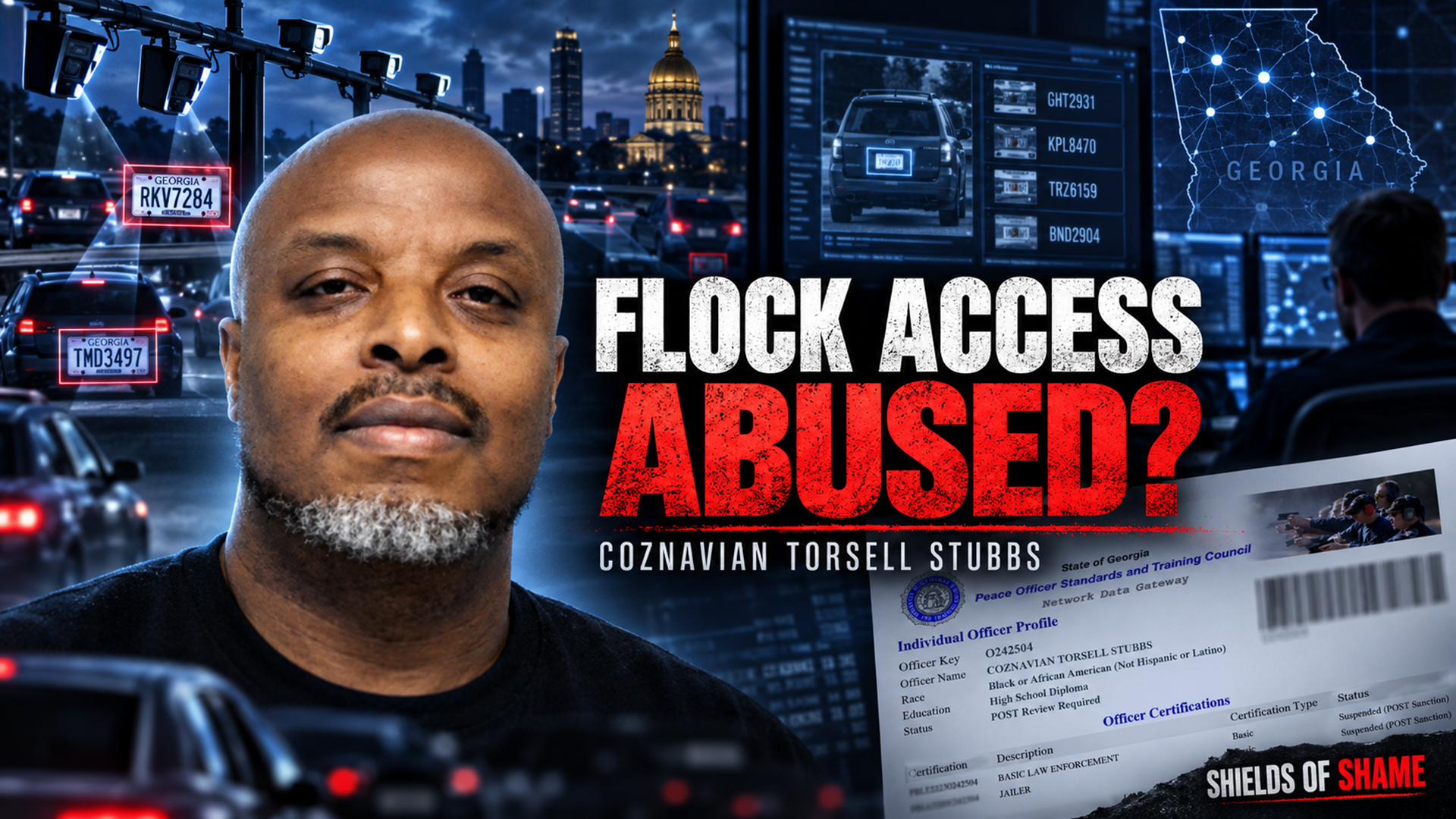
SHIELDS OF SHAME | FLOCK SURVEILLANCE INVESTIGATION | GEORGIA
Coznavian Stubbs: Bibb Deputy Charged With Stalking After Flock Camera Audit
Three deputies. Three separate alleged personal surveillance cases. One audit system that reportedly flagged questionable searches.
Case status: Arrested August 10, 2026; criminal charges reported; no conviction or final POST disposition verified in this update.
What Stubbs is accused of
Coznavian Torsell Stubbs, 45 at the time of his arrest, was one of three former Bibb County Sheriff’s Office deputies arrested August 10, 2026, after investigations into alleged misuse of Flock Safety automated license plate reader information. Officials said the cases were separate and that each concerned someone with whom the employee had a personal relationship. Stubbs was accused of accessing data for personal rather than legitimate law-enforcement purposes.
Published charging information lists violation of oath by a public officer, a charge involving prohibited retention or use of license plate reader data, and one count of stalking. These are allegations. Stubbs is presumed innocent unless and until proven guilty.
How the Flock alerts led to an investigation
Georgia Public Broadcasting reported August 4 that a monthly Bibb County Flock audit identified three queries flagged by Flock’s auditing algorithm. Deputies involved were temporarily locked out while Internal Affairs examined the activity. After arrests were announced, Sheriff David Davis said Flock had notified the agency of possible irregularities and that the internal audit conducted with company assistance uncovered the suspected misuse.
That sequence makes the audit process central to this case. The public needs to know whether the flagged activity represented three individual searches, three user accounts, or three groups of suspicious activity; what criteria triggered the alerts; and whether earlier audits contained warning signs.
GPB: Initial audit investigation ↗ | GPB: Arrests announced ↗
From jailer to corporal: the POST employment history
Shields of Shame’s original examination of Georgia Peace Officer Standards and Training Council records documents that Stubbs began with the Bibb County Sheriff’s Office as a jailer on November 6, 2019, and completed basic jail training in February 2020. He transferred into a peace officer position on June 23, 2023, and his employment record shows promotion to corporal on April 17, 2026.
News reports called Stubbs a patrol deputy. That designation does not necessarily conflict with corporal rank, but personnel records are needed to establish his actual assignment, supervisory authority and system privileges at the time of the alleged activity.
Timeline: promotion, audit, resignation, arrest
Nov. 6, 2019: Bibb County jailer employment begins, per historical POST profile.
June 23, 2023: Transfers to peace officer position.
April 17, 2026: POST employment history lists promotion to corporal.
Aug. 3–4, 2026: Agency reviews flagged Flock queries; GPB reports internal inquiry and temporary access restrictions.
Aug. 7, 2026: POST record lists voluntary resignation.
Aug. 10, 2026: Stubbs arrested; POST investigation date listed in original profile.
Sept. 16, 2026: Original SOS POST snapshot lists “POST Review Required.”
The unusual POST certification entries
The historical POST profile obtained by SOS listed both Stubbs’s basic law-enforcement certification and jailer certification as “Suspended (POST Sanction)”, while its sanctions section separately said “None Found.” The same snapshot listed an open investigation. Those entries are not enough to determine the reason for suspension, whether it was interim, or whether a final disciplinary order exists. An updated certified POST record and underlying notices are necessary.
The department once publicly praised Stubbs
Before the arrest, according to the original SOS reporting, the sheriff’s office highlighted Stubbs in a social-media post about a new Ford Explorer Interceptor and described him as a dedicated law-enforcement officer. His recorded promotion shortly before his departure raises legitimate questions about how performance reviews, database permissions, and internal accountability operated—but praise or promotion is not proof that administrators knew of misconduct.
Two other deputies were charged
Joseph Marquee Callaway, a former K-9 deputy, was charged with violation of oath, unauthorized request or disclosure of criminal-history information, a license plate data offense, and three stalking counts. Toni Cierra Lewis, a former patrol deputy, faced violation-of-oath, license plate data, and stalking charges. Officials emphasized that all three cases involved separate incidents and personal relationships.
Stubbs and Lewis resigned during the investigation; Callaway resigned shortly after his arrest. All three were booked and subsequently released, according to contemporaneous local reporting. No outcome of their criminal cases is inferred from release from custody.
41NBC: Arrest and charge details ↗ | Related SOS investigation: Joseph Callaway ↗
Why access was cut from more than 200 to about 100
Following the arrests, Sheriff Davis told 41NBC that more than 200 deputies previously had Flock access. That figure had fallen to slightly more than 100, and he intended to reduce it further. The move potentially reduces the number of users able to query sensitive vehicle sightings, but does not itself establish whether remaining accounts have appropriate permissions, routine audits, or effective alerts.
41NBC: Sheriff reduces Flock access ↗
The unanswered questions behind the stalking charge
Public reporting has not established the number of searches attributed to Stubbs, the dates of each query, the entered reasons or case numbers, whether any vehicle alerts or hotlists were created, whether results were shared, or the specific alleged conduct supporting the stalking count. It also remains unclear whether a complaint preceded the algorithm’s flag and whether supervisors had previously reviewed his search history.
The difference matters. An audit log may establish that a particular user searched for a vehicle, but it does not alone prove every element of criminal stalking. Investigators must examine the surrounding conduct, statutory elements and available evidence.
Public records investigation toolkit
Request 1 — ALPR audit material: Search history and audit reports identifying Stubbs’s account, timestamps, entered investigative purposes, alert triggers, review notes and available nonexempt fields.
Request 2 — Access administration: User account creation, privileges, supervisor approvals, changes, temporary suspension and deactivation dates.
Request 3 — Internal Affairs: Complaint intake, referral records, interview reports, sustained findings, disciplinary decisions and applicable ALPR policies, subject to statutory exemptions.
Request 4 — Criminal and POST records: Arrest warrants and affidavits, charging documents, docket and disposition, POST investigation notices and final orders when available.
Request 5 — System-wide controls: Audit frequency, Flock alerts, remediation communications, and access totals before and after the sheriff’s reduction.
Georgia law may restrict disclosure of captured license plate data and pending investigative records. Request segregable nonexempt records, ask for the legal basis of any redactions or withholding, and avoid publishing private persons’ plate numbers.
Independent sources and related investigations
CBS Atlanta: Three deputies arrested ↗
Georgia Public Broadcasting: Charges and oversight ↗
Institute for Justice: ALPR abuse database ↗
Original Shields of Shame case with historical records ↗
The oversight test
This case is not solely about one deputy’s alleged conduct. The arrest of three employees following flagged queries raises questions about the agency’s approach to system access, audit review and the protection of people whose travel patterns can be searched by government personnel. A company alert may have helped uncover the alleged activity; the next step is establishing what agency oversight did before and after that alert.
Editorial note — October 10, 2026: Criminal charges are allegations, not findings of guilt. The historical POST status described here is not represented as current. No later court disposition or final certification action was independently verified for this update.