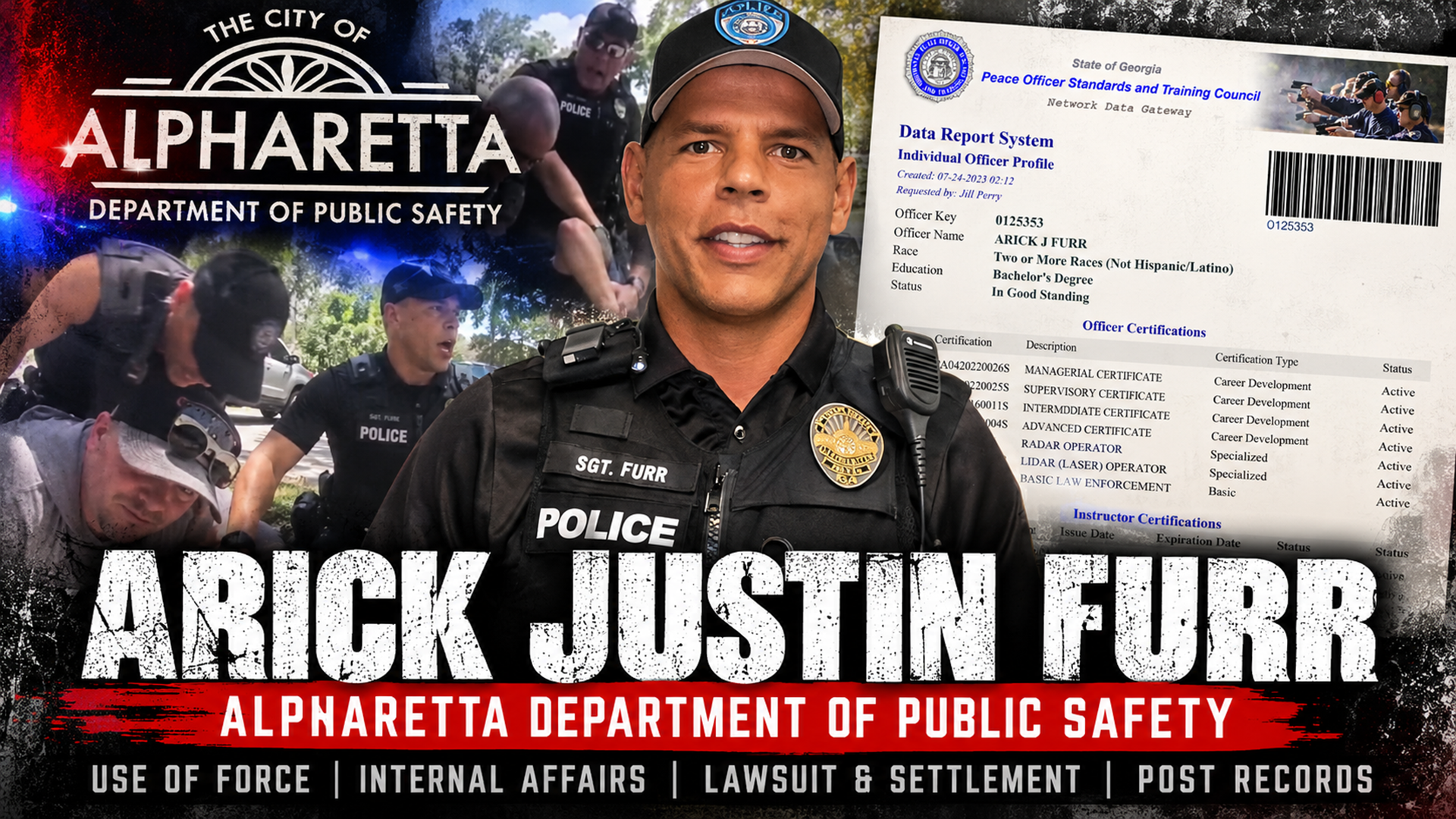
SHIELDS OF SHAME • ALPHARETTA, GEORGIA • FIRST AMENDMENT INVESTIGATION
Arick Justin Furr: Jeff Gray’s Arrest, Internal Affairs Records and Alpharetta’s $55,000 Free-Speech Settlement
A veteran held a sign outside City Hall. Police handcuffed him, turned off his camera and ordered him away. A federal lawsuit ultimately forced policy changes and a financial settlement.
January 27, 2022
January 31, 2023
July 15, 2024
$55,000 total
Where this started: Jeff Gray’s sidewalk encounter
On January 27, 2022, Army veteran and First Amendment activist Jeffrey Gray stood outside Alpharetta City Hall with a sign reading “God Bless the Homeless Vets.” According to Gray’s federal complaint and the Foundation for Individual Rights and Expression (FIRE), Lt. Arick Furr confronted him after complaints about alleged panhandling, demanded identification and ordered him to leave. Gray maintained he was raising awareness of homeless veterans rather than asking for money.
Furr handcuffed Gray, searched him for identification and turned off Gray’s video camera. FIRE reports that Furr said he was preserving its battery; Gray’s Apple Watch continued recording audio. Officer Harold Shoffeitt also participated in the encounter. Gray was released without criminal charges but was warned against returning to the sidewalk with his message. Gray’s suit challenged the detention, search, interruption of filming and exclusion from public space under the First, Fourth and Fourteenth Amendments.
FIRE case overview ↗ · Original federal complaint ↗
Watch Jeff Gray’s original series
Where it started — Jeff Gray series
Arrested & Banned — Alpharetta, Georgia
Update — Banned and Arrested
The First Amendment questions
Peaceful advocacy on a traditional public sidewalk receives strong constitutional protection. The government generally cannot treat the expression of support for homeless veterans as unlawful simply because it dislikes the message or characterizes it as panhandling. Even actual requests for charitable help may constitute protected speech, subject to properly tailored and lawful restrictions. A police officer’s ability to require identification or search someone is a separate Fourth Amendment question, dependent on lawful grounds for detention and search. The right to record officers performing public duties is also a central issue in the lawsuit.
Gray’s lawyers argued that officers misapplied panhandling rules and used a trespass notice to bar protected speech. Those were claims in litigation; the eventual settlement resolved the dispute without an admission of liability.
What Alpharetta’s internal review found
Publicly reported records indicate Furr was disciplined after the encounter. The Atlanta Journal-Constitution reported that Alpharetta’s public information officer acknowledged Furr violated department policy and that he was suspended and required to complete additional training. FIRE’s case-document library contains a February 28, 2022 internal-affairs findings memorandum and a March 3, 2022 disciplinary action request form. These official materials should be compared directly with the two IA files in the Shields of Shame archive before assigning precise findings to each supplied document.
FIRE’s full document library: IA findings, discipline, policies and settlement ↗
2023 federal lawsuit: Gray v. City of Alpharetta
On January 31, 2023, Gray sued the City of Alpharetta, Arick Furr and Harold Shoffeitt in the U.S. District Court for the Northern District of Georgia, Case No. 1:23-cv-00463-MLB. The complaint challenged a pattern of treating panhandling as categorically illegal and alleged that Gray was detained, searched, prevented from filming and banned from exercising protected speech outside City Hall. The defendants disputed liability.
Federal case docket ↗ · Filed complaint ↗
July 2024: $55,000 settlement and policy reforms
Alpharetta settled on July 15, 2024, agreeing to pay $55,000 in total, including damages and legal fees. The city agreed to stop officers from making blanket claims that panhandling is illegal; provide First Amendment training in 2024 and 2025; and adopt procedures addressing officers who violate First Amendment rights. FIRE’s published agreement and related policies also address trespass notices in public spaces and review of constitutional-rights complaints. The settlement states that the defendants continued to deny liability.
Read full settlement agreement ↗ · FIRE settlement announcement ↗ · FOX 5 Atlanta reporting ↗
Alpharetta’s $55,000 payment and policy changes are documented. They do not amount to a jury verdict finding that every allegation against Furr or Shoffeitt was proven. Separately, the department’s own disciplinary findings should be described using the language of the actual IA records.
Shields of Shame evidence vault: all nine supplied assets
These records were supplied for this investigation and are preserved as direct source links. Each opens in a separate tab. Their exact internal findings should be confirmed from the documents themselves; a file’s label alone does not establish a sustained complaint or unlawful force.
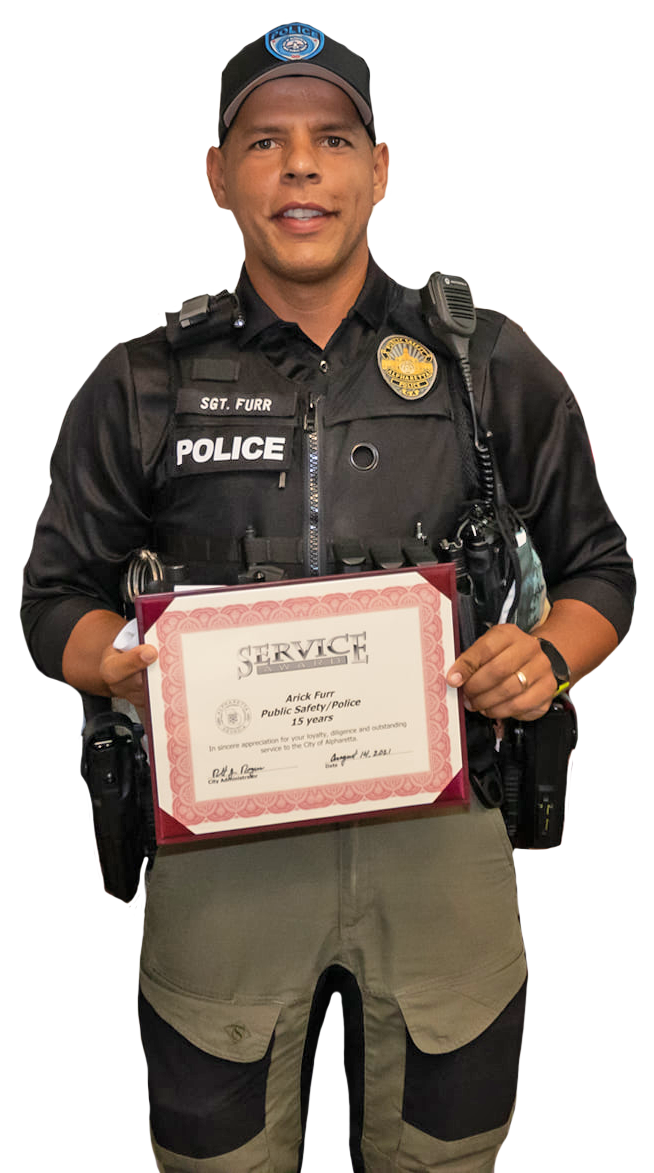
Original supplied visual reference.
Original IA-format document. Some browsers download rather than display DOC files.
Second supplied internal-affairs document; inspect findings and dates.
First supplied force-related record; outcome not independently established.
Second supplied force-related record; outcome not independently established.
Third supplied force-related record; outcome not independently established.
Fourth supplied force-related record; outcome not independently established.
Source for reviewing certification and employment status; avoid inferring current standing without verification.
Additional department-level source material.
Chronology
- Jan. 27, 2022: Gray’s sign-holding encounter, handcuffing, search and trespass warning outside City Hall.
- Feb. 2022: Department internal review and IA findings memorandum.
- Mar. 3, 2022: Furr disciplinary action request documented in FIRE’s records library.
- Jan. 31, 2023: Gray files federal civil-rights lawsuit.
- July 15, 2024: City and Gray reach a $55,000 settlement with policy commitments.
- July 18, 2024: Updated Alpharetta First Amendment and trespass-related policies appear in FIRE’s source library.
Open-records toolkit: what to request next
To independently audit the Gray incident and the other Furr-related records, request the full unredacted-to-the-extent-lawful IA case file; complaint intake; interviews; findings; disciplinary notices; supervisor correspondence; all related BWC and in-car recordings; camera activation, access and deletion audit trails; CAD and radio logs; trespass notice; applicable policies in effect on January 27, 2022; use-of-force reports and supervisor reviews for each separately identified event; and POST certification and employment notifications. Ask for the exact record identifier, incident date, disposition and responsive footage for each UOF file, rather than assuming four separate incidents.
Under Georgia’s Open Records Act, agencies generally must respond within three business days, with statutory exceptions and timing rules for production. Request an itemized estimate and citations for any withheld material. Georgia Open Records Act § 50-18-71 ↗
Why this matters beyond one encounter
The importance of this case is not limited to one sign or one lieutenant. A veteran’s encounter with police prompted public scrutiny, an internal disciplinary process, a federal civil-rights suit, a monetary settlement and written changes in how an entire police department must approach speech in public places. The central accountability question now is whether the reforms were implemented consistently and whether the city’s internal records match the promises made in the settlement.