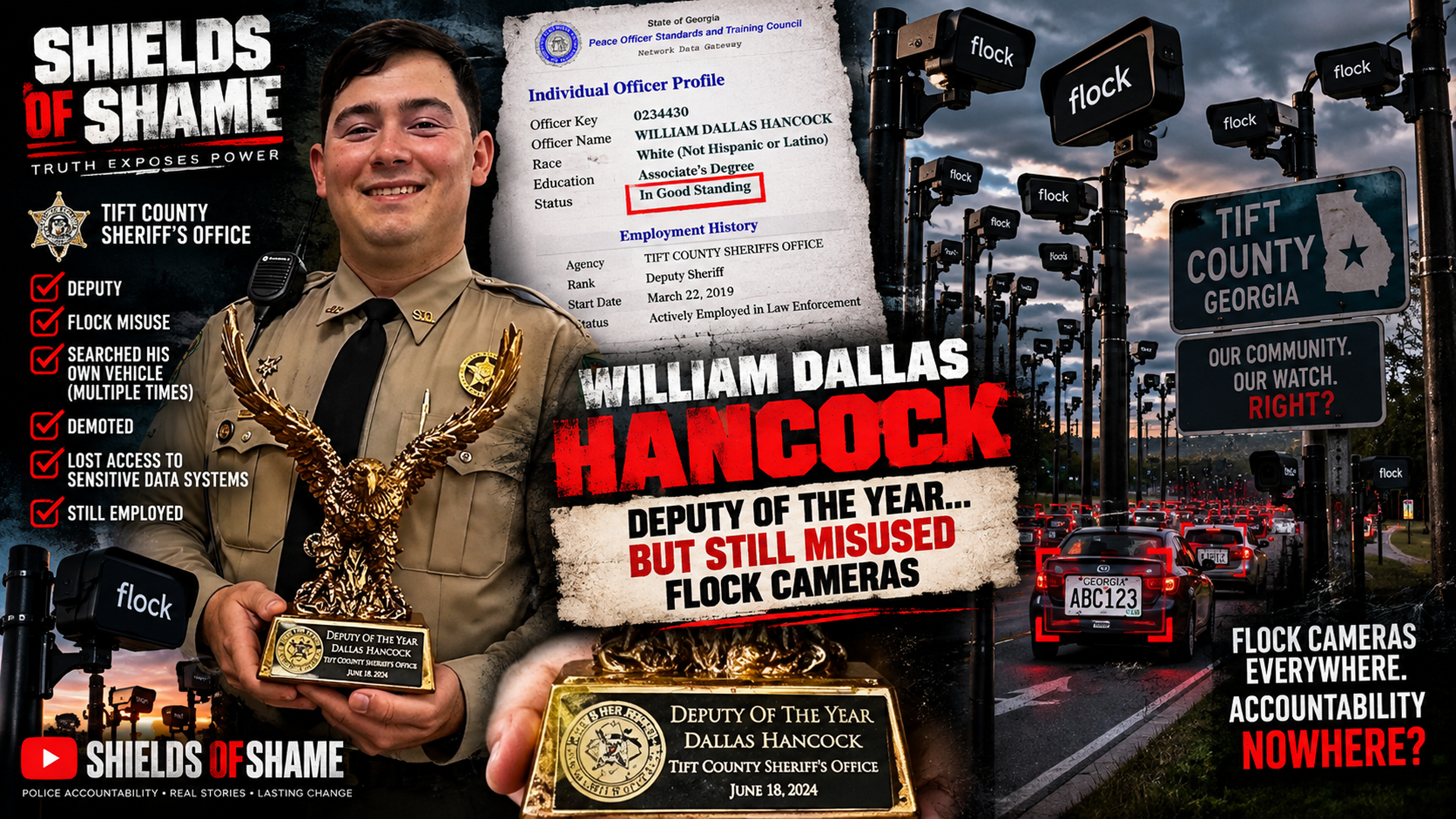
SHIELDS OF SHAME | GEORGIA FLOCK DATABASE | TIFT COUNTY
William Dallas Hancock: Tift County Deputy Demoted After Repeatedly Searching His Own License Plate in Flock
From a Deputy of the Year recognition to a demotion and loss of access to confidential police databases. William Dallas “Dallas” Hancock remained employed by the Tift County Sheriff’s Office after an internal investigation found he had repeatedly searched his personal automobile tag using the agency’s Flock license plate reader system. The sheriff’s office characterized the searches as a policy violation but specifically said it found no evidence Hancock accessed another person’s data or improperly used the information he retrieved. The department also stated his access to his own plate information did not violate Georgia law. Those distinctions are essential to understanding this case.

What the internal audit uncovered
The Tift County Sheriff’s Office discovered discrepancies while auditing law-enforcement data systems, according to reporting by WALB. Investigators subsequently determined that Hancock had searched his own automobile tag numerous times using the Flock system. Neither the exact number of queries nor their dates, recorded search purposes or case-number fields were publicly specified in the sheriff’s account. It is therefore not established that the searches were used to follow anyone else, investigate a particular person or obtain information about another vehicle.
On September 3, 2026, WALB identified Hancock after Tift County Attorney Jennifer Herzog supplied his name. The agency explicitly said it had found no evidence he accessed anyone else’s data or used the accessed information improperly. Leadership nevertheless concluded the searches were improper under agency rules. WALB, September 3 — Hancock identified and agency findings ↗
Demoted, not fired — and no reported criminal charge
The disciplinary outcome was a demotion from a recent promotion and revocation of access to sensitive, confidential law-enforcement data systems. Hancock was not terminated in the reported action. No Flock-related criminal charges were reported in the reviewed coverage. The sheriff’s office said searching his own plate was a policy violation, not a violation of Georgia law under the circumstances it reviewed. This differs from other Georgia cases alleging unauthorized searches of another person’s vehicle, and those situations should not be treated as legally interchangeable.
Sheriff Gene Scarbrough reportedly issued an agency-wide memorandum emphasizing zero tolerance for conduct that undermines public trust and directing personnel to review the policies governing confidential databases. WALB, August 31 — disciplinary action and sheriff’s memorandum ↗
Deputy of the Year recognition
One of the supplied images documents Hancock’s recognition as Deputy of the Year. That recognition is part of his professional history and makes the contrast with subsequent discipline notable, but an award does not determine whether an employee followed database-access rules. The key accountability question is what searches occurred and what policy applied at the time.
What his Georgia POST record shows
The supplied Georgia POST certification screenshot reportedly listed Hancock as actively employed and in good standing, with no POST sanctions or investigations appearing in that snapshot. This should be interpreted narrowly: internal agency discipline and POST disciplinary proceedings are not the same thing. A demotion can occur without a criminal charge or a POST sanction. An administrative screenshot also reflects its generation date and may not capture later developments.
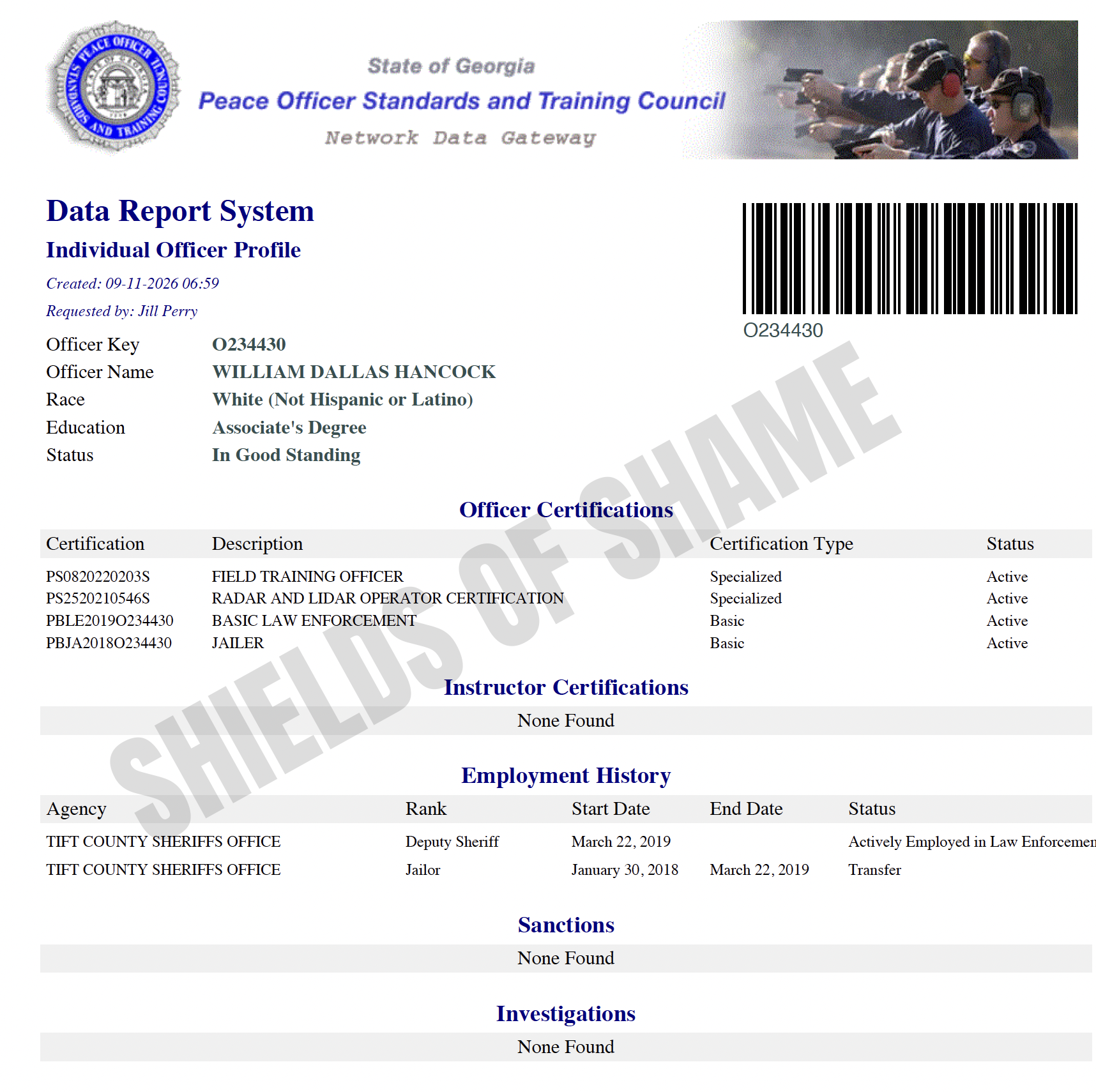
View original Georgia POST certification image ↗
Read supplied Hancock case document (PDF) ↗
Why search audits matter even when no crime is alleged
Flock automated license plate readers collect vehicle plate observations and associated time and location information. Searches can support criminal investigations, but access controls are intended to prevent officers from treating sensitive systems as personal research tools. Even where a search concerns an officer’s own car and investigators find no harm to another person, the conduct can reveal whether database permissions, documented investigative purposes and supervisory auditing are being enforced consistently.
The public interest is not served by overstating Hancock’s conduct. The sheriff’s findings, as reported, did not accuse him of stalking someone or retrieving a third party’s data. Instead, they establish an internal policy violation involving repeated self-queries, followed by an employment consequence. That is significant on its own.
Chronology
- Before late August 2026: Tift County audit detects discrepancies and an internal investigation examines Flock access.
- August 31, 2026: WALB reports a deputy was demoted and lost confidential-system access following an investigation.
- September 1, 2026: Follow-up reporting describes the department’s discipline and agency-wide policy reminder.
- September 3, 2026: WALB identifies the deputy as Dallas Hancock and reports the agency’s finding that he searched his own automobile tag numerous times.
- October 2026: Shields of Shame republishes the case with supplied POST and supporting materials; the exact query count remains an open records question.
What the complete audit trail should establish
A targeted Georgia Open Records Act request should seek the Flock account activity and native search export for Hancock’s user ID, including each query timestamp, plate searched, recorded justification, associated case number, any result exports or sharing, audit alerts, and supervisor review notes. Also request the internal affairs findings, demotion and access-revocation records, the sheriff’s policy memorandum, the operative ALPR policy, database training acknowledgments, and any POST notification. Agencies should identify specific exemptions for withheld material and release nonexempt portions.
Original documents and image gallery

Frequently asked questions
What did Hancock search?
According to the sheriff’s office, he repeatedly queried his own personal automobile tag in Flock.
Did he search another person’s plate?
The sheriff’s office said its investigation found no evidence he accessed anyone else’s data.
Was he fired?
No. He was demoted from a recent promotion and his access to confidential databases was revoked.
Was Hancock criminally charged?
No Flock-related charge was reported in the reviewed sources. The sheriff’s office said the self-queries violated policy, not Georgia law.
How many searches were made?
The department described numerous searches but did not publicly disclose an exact count in the reporting reviewed.
Why does the POST profile show no sanction?
Agency discipline does not automatically mean a separate Georgia POST sanction. The supplied snapshot should not be treated as a current or final certification determination.
Related coverage and investigations
Original Shields of Shame case investigation ↗
Taylor Lynn McArthur — Hall County Flock audit ↗
Robert M. Keim — GDC Professional Standards investigation ↗
Editorial note: This case concerns substantiated agency-policy misuse, not a reported criminal conviction. The Tift County Sheriff’s Office stated it found no evidence Hancock accessed another person’s information or used the data improperly. Original audit records are needed to determine the full search history. Updated October 13, 2026.