
SHIELDS OF SHAME | COBB COUNTY, GEORGIA | CASE FILE
Jason Anthony Bill: Cobb County Deputy Convicted of Rape, Kidnapping and Sexual Assault
A badge, a gun, a terrified woman, and a criminal case that ended in a life sentence plus 20 years. The court record reveals what happened, how the victim escaped, and why the convictions survived appeal.
Case status: Convicted following jury trial in 2011; convictions affirmed on April 20, 2017. Former agency: Cobb County Sheriff’s Office. Georgia POST: basic law-enforcement and jailer certifications revoked March 21, 2011. GDC ID: 1000504840. The supplied corrections screenshot lists him as actively serving a life sentence; it is a snapshot, not a live inmate-status verification.
The Night of July 14, 2008: A Deputy Uses His Badge
The Georgia Court of Appeals recounts a deeply disturbing sequence. The victim, originally from El Salvador, spoke no English and worked at a bar near the apartment complex where she and Jason Anthony Bill lived. Bill, then a Cobb County sheriff’s deputy, sometimes visited the bar. On July 14, 2008, he entered while she was working. Witness evidence described him as angry and intoxicated, and the bar owner asked him to leave. He returned with a gun.
According to the appellate court’s account of the trial evidence, Bill called the woman over, displayed his law-enforcement badge and grabbed her arm. He put her inside his truck and locked the doors. The woman believed she was being arrested. That mistaken belief was central to the abuse of authority: the symbols of official power helped him gain control of a civilian who had no reason to expect what came next.
Instead of driving to a detention facility, Bill drove to his own apartment. There, according to the evidence summarized by the court, he handcuffed the woman, threatened her with a firearm and forced sexual acts. The court described a prolonged assault that included rape, aggravated sodomy, aggravated sexual battery, blows with hands and a belt, and attempted strangulation using her clothing. The victim was bound and gagged to prevent her from leaving. These are not merely untested internet accusations: a jury convicted Bill of the offenses, and an appellate court affirmed.
Her Escape and the Witness Who Opened the Door
The victim eventually managed to free herself from the restraints and flee Bill’s apartment. She knocked on neighbors’ doors for help. An 11-year-old girl testified that shortly before midnight she answered a knock at her grandmother’s apartment and found the woman unclothed, handcuffed and visibly beaten. The grandmother gave her a robe and police were called.
The language barrier made an already frightening situation more difficult. The victim spoke Spanish and the family could not understand her, but she pointed to a man on a motorcycle slowly circling the complex. A family member directed arriving officers toward the motorcycle. Police found Bill near it and arrested him. The victim later identified him as her attacker. This eyewitness sequence is described in the published appellate decision and provides unusually specific independent corroboration of the escape and immediate aftermath.
Criminal Charges, Jury Verdict and Sentence
Records supplied to Shields of Shame and the published appellate opinion identify convictions for kidnapping, rape, aggravated sodomy, aggravated sexual battery, aggravated assault and false imprisonment. The POST summary states that arrest warrants were issued around July 15, 2008, that Bill was terminated from law enforcement around that date, and that his certifications were suspended. It reports a guilty verdict in March 2011 and a sentence of life imprisonment plus 20 years. The sentencing terms listed for individual counts in the corrections screenshot are not a reliable basis for adding every count together: some sentences run concurrently and the underlying judgment controls.
The Georgia Department of Corrections screenshot identifies Jason Anthony Bill under GDC ID 1000504840 and lists Long Unit as the most recent institution shown, with an active incarceration status. The record displays a life maximum possible release date. These are details shown on the provided record, not a guarantee of his precise present housing assignment or future release eligibility.
The Defense at Trial
Bill testified and denied assaulting the woman. He claimed he had previously paid her for sex and that they had arranged another encounter on July 14, but that they only kissed that evening. The woman rejected that account. The jury found him guilty on all six categories of offenses discussed in the appellate opinion.
His defense also sought to introduce allegations about the victim’s prior sexual history and suggested that other individuals might have injured her. The trial court excluded certain material as irrelevant and speculative. On appeal, the judges agreed there was no evidentiary connection between those suggestions and the charged assault. The opinion also explains that some testimony about Bill’s alleged prior dealings with the victim was actually admitted, so the jury heard part of his version. The court did not accept his claim that additional testimony required a new trial.
The 2017 Appeal: Six Arguments, No Reversal
In Bill v. State, No. A17A0790, decided April 20, 2017, the Georgia Court of Appeals reviewed the evidentiary rulings, the prosecutor’s questioning, rebuttal testimony and jury instructions. The court rejected Bill’s arguments and affirmed the judgment.
1. Sexual-history evidence and the rape-shield law
Bill argued that allegations about prostitution should have been admitted to suggest an alternative perpetrator or impeach the victim. The appeals court held the proposed connection to the assault was speculation, and that the evidence was not shown to contradict the relevant testimony. It also noted that the jury had already heard Bill’s account of allegedly paying for sex.
2. A previous sexual-assault report
The defense sought to use a prior report made on behalf of a roommate and argued that the victim had motives to fabricate allegations, including possible immigration relief and civil litigation. The appeals court noted that the trial judge permitted evidence about the prior report, lawsuit and visa issue, but the defense had not established a reasonable probability that the earlier report was false. The defense itself agreed not to label that report false before the jury.
3. The victim’s rebuttal testimony
After Bill testified, prosecutors recalled the victim to address his assertions about their supposed prior sexual relationship and her purported willingness to go to his apartment. She denied those claims. The appeals court found this was proper rebuttal to the defense evidence.
4. Military service and drinking
Bill, an Iraq War veteran, wanted to present testimony about a close friend’s death in Iraq to help explain his drinking. The appellate court held the excluded testimony did not illuminate the alleged crimes and observed that Bill had already testified about his deployments and increased drinking after returning.
5. Prosecutor’s question and mistrial motion
The prosecutor made a remark during cross-examination about not knowing of Bill’s claimed prior relationship with the victim. The trial court sustained the defense objection and instructed jurors to disregard the question. Because the defense did not renew its mistrial request after the corrective instruction, the appellate court found that issue waived.
6. The jury instruction about physical injuries
Bill challenged an instruction explaining that physical trauma is not a required element of rape or aggravated sexual battery. The appellate court found the instruction correctly stated the law and did not improperly comment on the evidence. The result: judgment affirmed.
↗ READ FULL 2017 APPELLATE OPINION
A Separate Civil Lawsuit: Claims of Threatened Deportation
Courthouse News Service reported a lawsuit brought by the victim, identified in that coverage by initials, against Bill and additional defendants including county-related parties and the restaurant-bar. According to the reported civil complaint, Bill wore his badge, appeared intoxicated and threatened to have the woman deported while removing her from her workplace. These are allegations in a civil pleading, not separate criminal findings established by the appellate opinion.
The civil complaint raises questions that reach beyond one deputy: Did anyone at the business recognize the danger? Did supervisory personnel have warning signs? What did the agency know about Bill’s conduct or alcohol use before the attack? A lawsuit’s filing does not establish liability for every named defendant. The disposition of this civil case has not been independently verified in this report, so Shields of Shame does not characterize it as a settlement or judgment.
↗ COURTHOUSE NEWS: CIVIL LAWSUIT
Georgia POST Records: From Deputy to Decertified
The Georgia Peace Officer Standards and Training record, generated August 17, 2026, lists Bill as a Cobb County Sheriff’s Office peace officer from December 31, 2000, through July 15, 2008, with employment status terminated. Both his basic law-enforcement certification (PBLE011333S) and jailer certification (PBJA010181S) are listed as revoked. POST records show final action on March 21, 2011.
These records matter because the criminal sentence and the professional licensing consequence are separate forms of accountability. The POST file documents the formal loss of credentials, while the appellate opinion documents the underlying criminal adjudication. The training history also shows courses covering restraint, use of force, firearms, ethics and integrity, among other subjects. Training does not establish that an agency knew an employee would commit a crime, but the records provide context for the authority and responsibilities attached to the position.
Timeline of the Documented Case
- December 31, 2000: POST lists the start of Bill’s Cobb County Sheriff’s Office employment.
- July 14, 2008: Assault documented in the later appellate opinion.
- July 15, 2008: Approximate warrant, termination and certification-suspension dates stated in the POST case summary.
- February–March 2011: Jury trial and convictions; POST summary records sentencing in March.
- March 21, 2011: POST revokes his law-enforcement and jailer certifications.
- April 20, 2017: Georgia Court of Appeals affirms the criminal judgment.
- August 17, 2026: Date on the POST officer-profile report supplied for this investigation.
Primary Documents and Evidence Library
Shields of Shame makes the underlying records available so readers can inspect the evidence themselves. Every document button opens in a separate browser tab.
↗ Georgia POST Officer Certification and Training Record↗ Georgia POST Case Summary↗ Georgia Department of Corrections Inmate Record
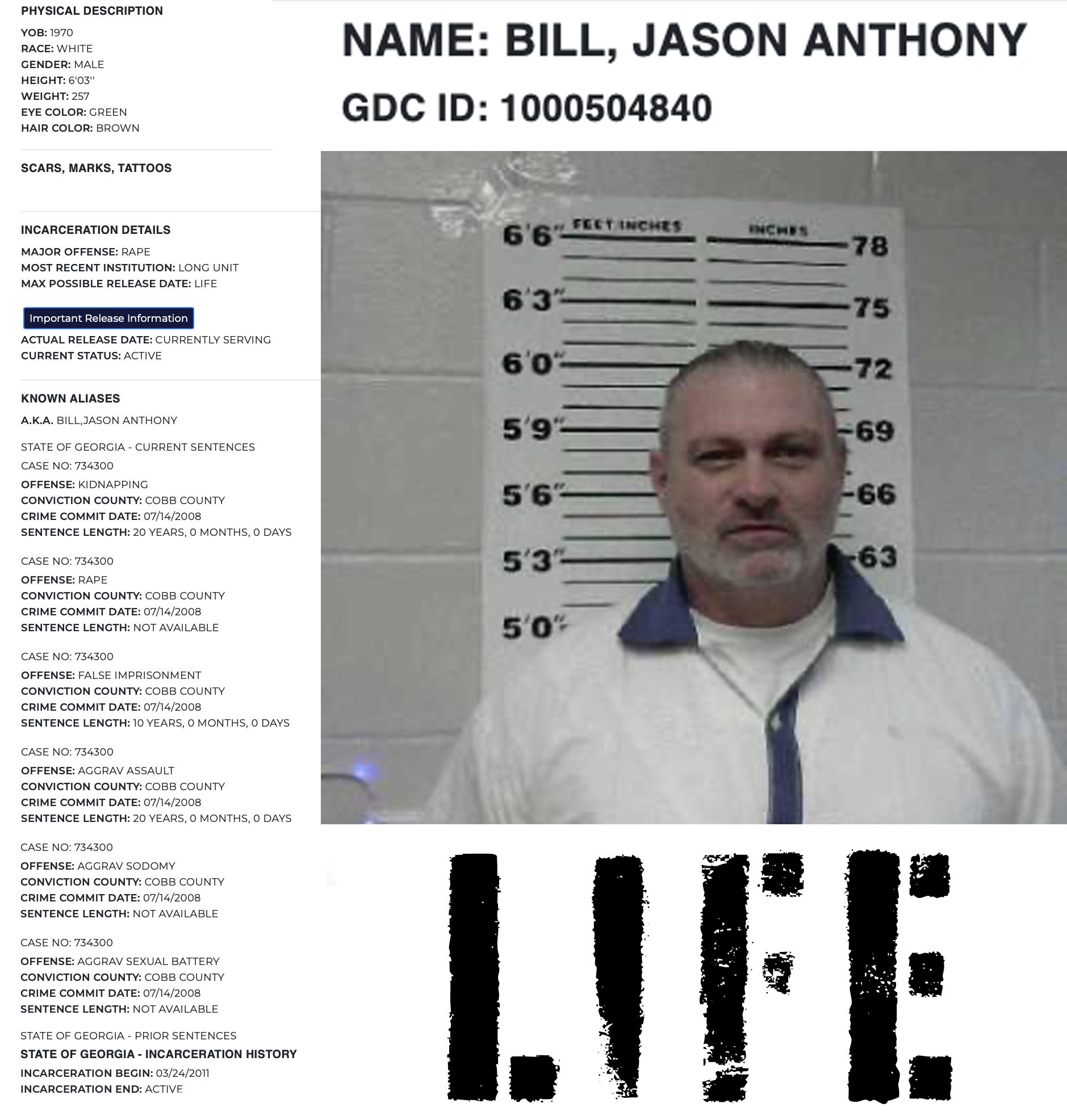
What the Records Establish — and What Remains Open
Established: Bill was a Cobb County deputy; he was convicted by a jury of serious violent and sexual offenses; the convictions were affirmed on appeal; POST revoked his credentials; the supplied corrections record lists active incarceration. Not independently established here: the final outcome of the separate civil litigation, any monetary settlement, Bill’s precise current facility, or any new post-2017 appellate ruling. The absence of an identified update is not proof none exists.
Important remaining records for follow-up include the original 2008 incident and arrest reports, the trial judgment and sentencing order, any internal-affairs and supervisory review, and the civil docket and disposition. These could clarify the agency’s response and whether warning signs existed before the crime.
Why This Case Matters
This case is a stark example of what happens when a law-enforcement officer uses the appearance of official authority as an instrument of coercion. The victim believed the badge meant she was under arrest. The court record describes how that belief was exploited, how a neighbor’s family helped her escape, and how the criminal justice system ultimately convicted the deputy. Accountability journalism must distinguish proven criminal conduct from unresolved civil allegations while preserving the documentary trail for the public.
Shields of Shame investigative archive. Sources: Georgia POST officer profile and case summary; Georgia Department of Corrections screenshot supplied for this investigation; Bill v. State, Georgia Court of Appeals, A17A0790 (2017); Courthouse News Service civil-litigation reporting. Updated October 8, 2026. For corrections or additional records, contact Shields of Shame.