
Shields of Shame | Georgia Police Accountability
Protective Order Gets Valdosta Police Officer Fired
Billy Joe Cribb Jr. was terminated after a court order restricted his ability to carry a firearm. Months later, he was arrested after visiting his former girlfriend’s workplace despite the order. He eventually pleaded guilty to a misdemeanor, and Georgia POST revoked his certification.
How a Protective Order Ended a Police Career
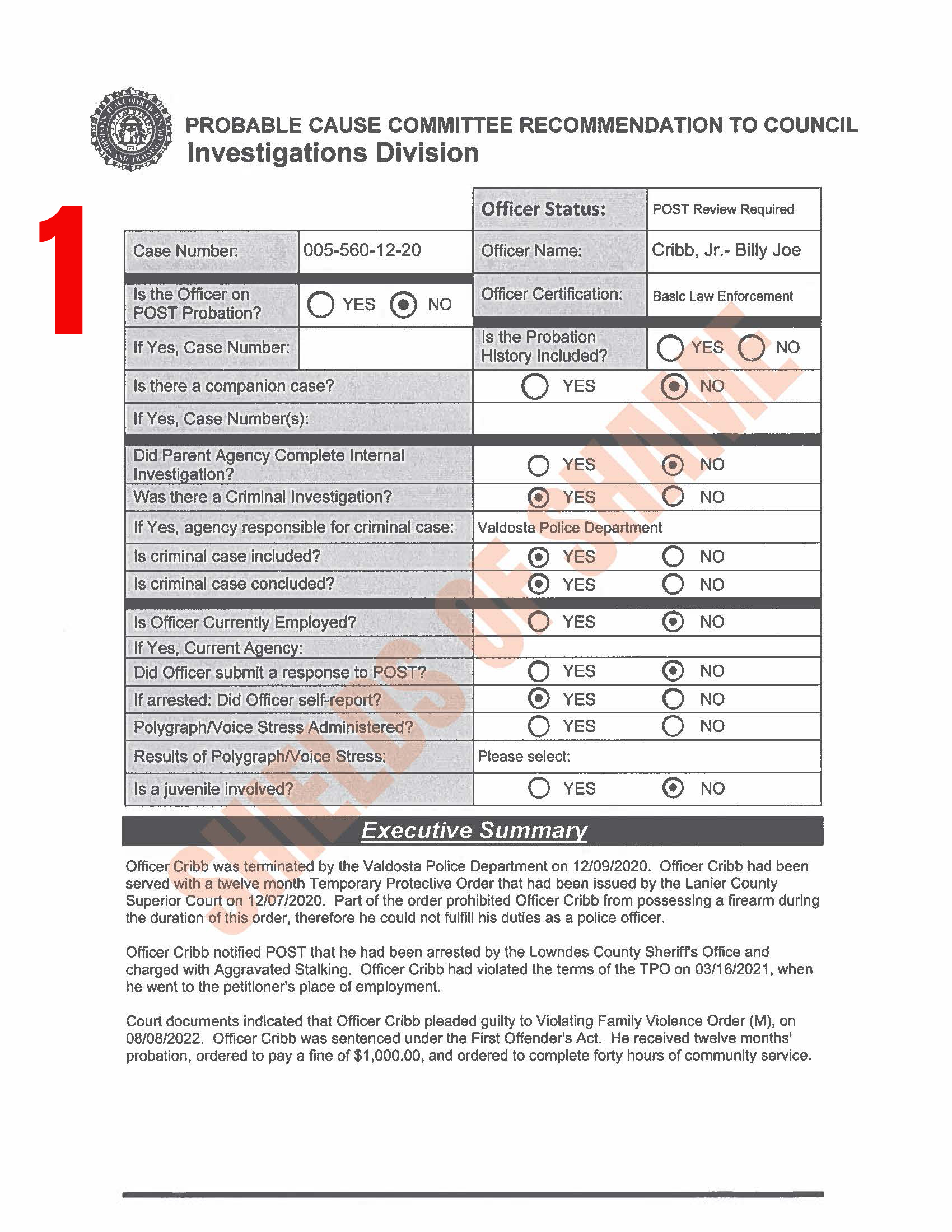
Police officers are expected to enforce court orders. In this case, a court order directly affected the career of a Valdosta police officer. Georgia Peace Officer Standards and Training Council records state that Billy Joe Cribb Jr. was terminated on December 9, 2020, after a 12-month temporary protective order barred him from possessing a firearm. The firearm restriction meant he could not perform his police duties.
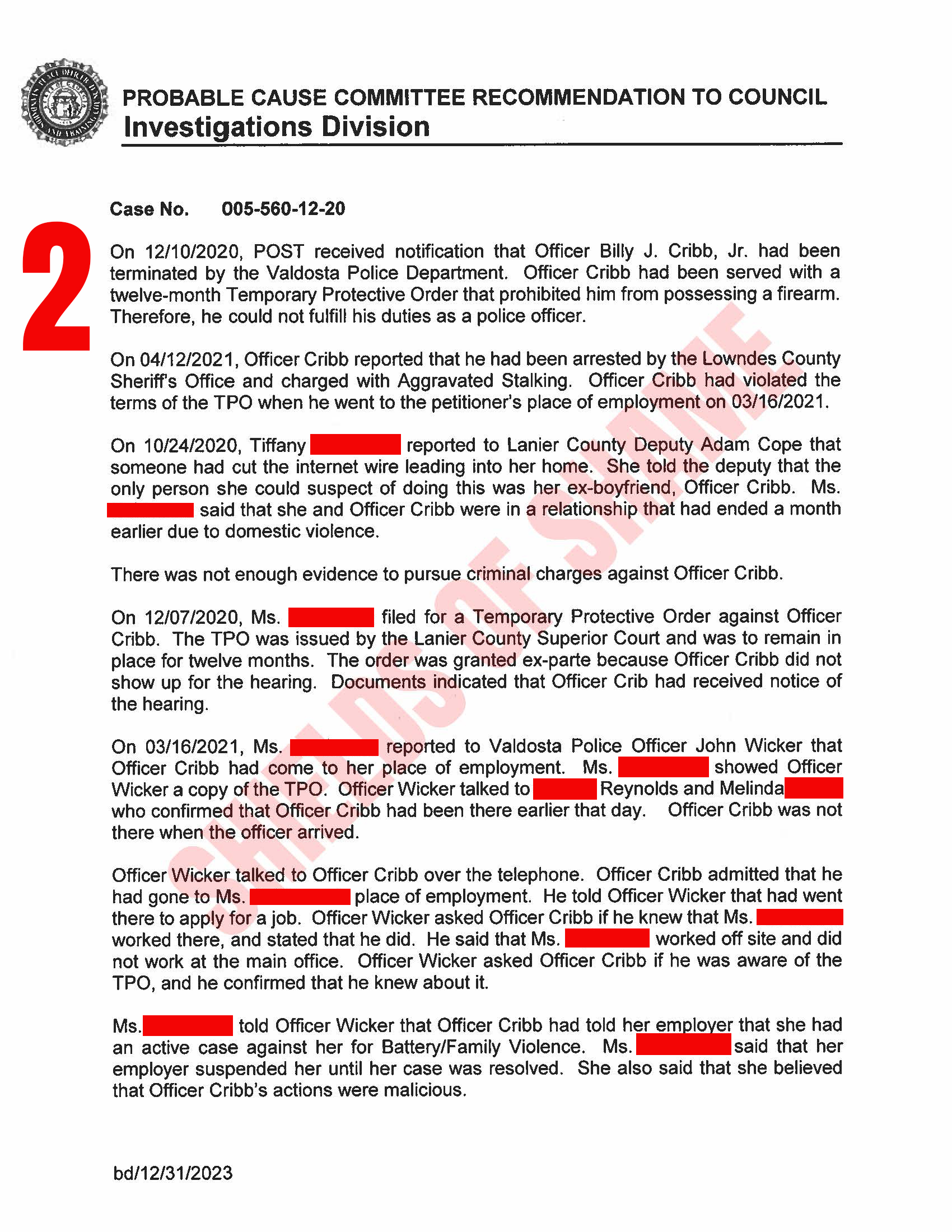
The underlying dispute involved Cribb’s former girlfriend, Tiffany Kuhlmann. According to the POST case summary, she had reported a damaged internet wire at her home in October 2020 and suspected Cribb. Investigators did not find sufficient evidence to pursue criminal charges in connection with that report. That allegation must not be confused with the later documented criminal conviction.
What Happened at the Workplace?
On March 16, 2021, Kuhlmann reported that Cribb had visited her place of employment. Valdosta Police Officer John Wicker responded, reviewed the protective order, and spoke with two individuals who confirmed Cribb had been at the workplace earlier that day, according to the POST investigative summary.
When Wicker called Cribb, the former officer acknowledged visiting the workplace and said he had gone there to apply for a job. He also acknowledged knowing about the protective order and knowing Kuhlmann worked there, while explaining that she worked off site rather than in the main office.
Kuhlmann additionally alleged that Cribb told her employer she had an active battery or family violence case. She reported that her employer suspended her until the matter was resolved. Those statements are attributed to her account in the POST report, not presented as independent judicial findings.
Arrest, Guilty Plea and Sentence
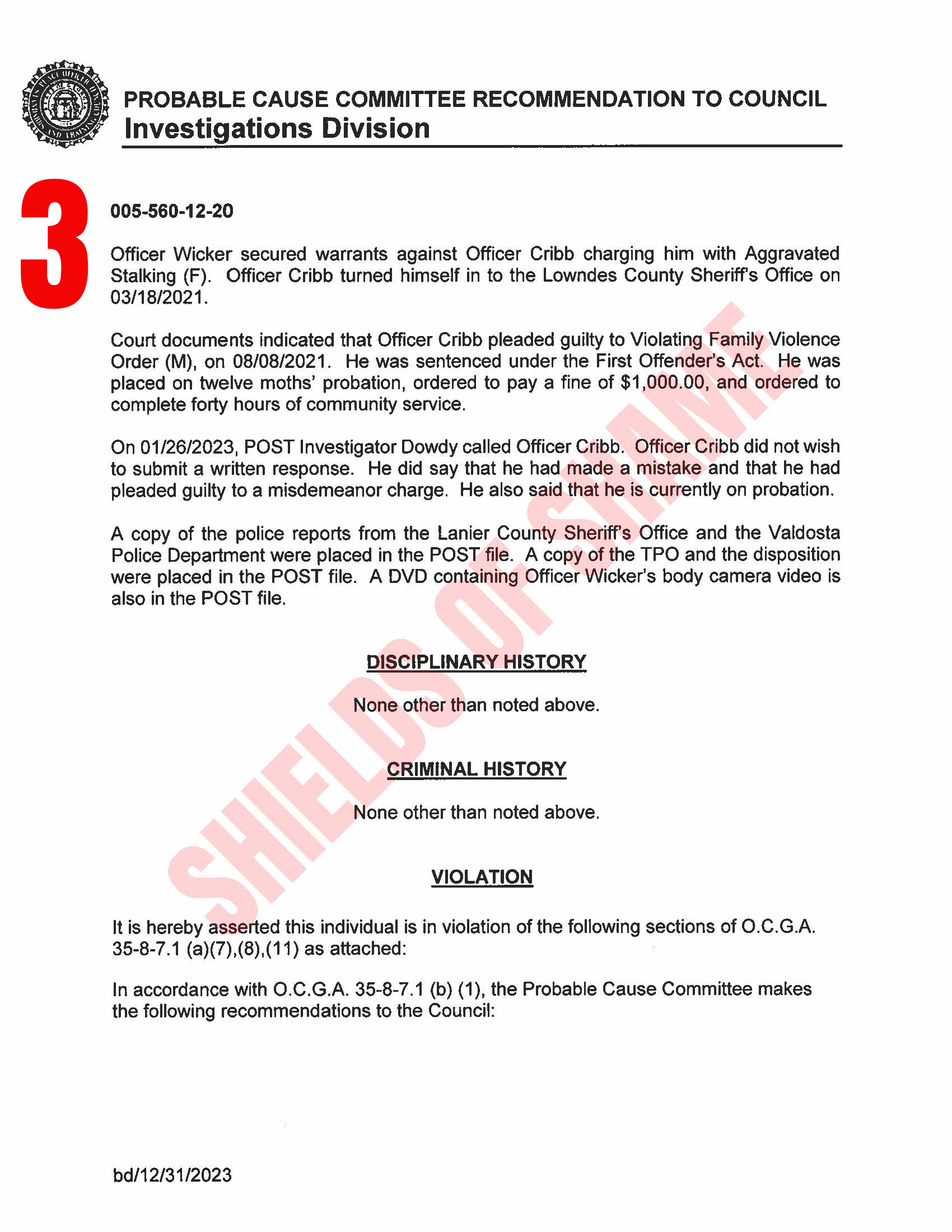
Cribb turned himself in to the Lowndes County Sheriff’s Office on March 18, 2021, according to the POST case summary. Court documents summarized by POST record a guilty plea on August 8, 2022, to violating a family violence order, a misdemeanor.
His sentence included 12 months of probation, a $1,000 fine and 40 hours of community service under Georgia’s First Offender Act. The precise legal effect of First Offender treatment should be determined from the complete court disposition; this article does not assume whether an adjudication of guilt was entered.
Georgia POST Revokes His Certification
POST investigators reviewed police reports, court records, the protective order and the disposition. In January 2023, Cribb told a POST investigator he had made a mistake, acknowledged his misdemeanor guilty plea, and declined to provide a written response, according to the summary.
The officer’s POST profile, generated October 14, 2026, lists his basic law enforcement certification as revoked. The final action date is July 28, 2023. His recorded employment with Valdosta Police lasted just over eight months.
Timeline of the Case
April 2, 2020: Cribb begins employment with Valdosta Police Department.
October 24, 2020: Kuhlmann reports a cut internet wire. Insufficient evidence is found to pursue charges related to that allegation.
December 2020: Lanier County Superior Court issues a 12-month protective order.
December 9, 2020: Cribb’s police employment ends.
March 16, 2021: Workplace visit is reported to Valdosta Police.
March 18, 2021: Cribb turns himself in following an aggravated stalking charge.
August 8, 2022: Misdemeanor guilty plea and First Offender sentence documented by POST.
January 26, 2023: POST investigator speaks with Cribb.
July 28, 2023: Georgia POST revokes basic law enforcement certification.
Video Evidence
The following video was supplied for this investigation. View the footage alongside the source documents below. Its exact scenes and provenance should be verified before describing it as a particular officer’s body camera recording.
Read the Original Documents
These records allow readers to examine the underlying evidence rather than rely solely on a summary. The court motion and court image are provided as supporting source material; their specific contents should be checked against the complete filings.
POST Investigative Summary: Page Images
Click any page image to open the full-resolution version.
Why This Case Matters
Protective orders are court directives, not optional suggestions. When a police officer becomes subject to an order that restricts firearm possession, the consequences can extend to employment and certification. This case also shows why accurate reporting requires separating an initial arrest charge from the offense to which someone ultimately pleads guilty.
Another unanswered question concerns the available video evidence. The POST summary states that the investigative file included a DVD containing Officer Wicker’s body camera recording. That record could help the public understand what officers documented and how the allegations were investigated.
Shields of Shame | Follow the Evidence
Shields of Shame examines police misconduct allegations, official disciplinary findings, criminal proceedings and public records. Source materials are provided so readers can assess the evidence for themselves. Allegations are distinguished from established findings, and an arrest is not proof of guilt.
Have additional verified records about this case? Contact Shields of Shame through the website.