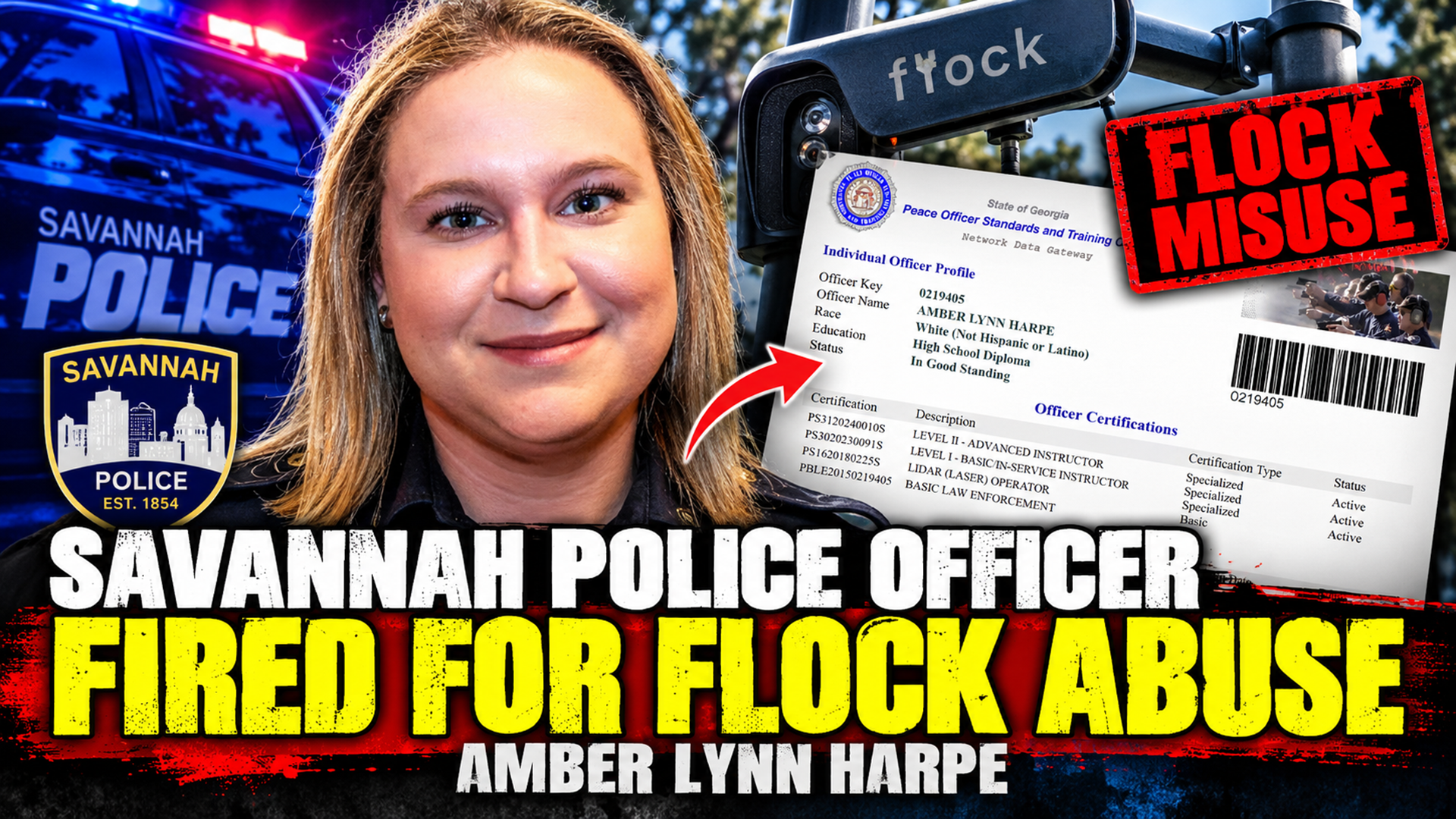
SHIELDS OF SHAME | FLOCK SAFETY ACCOUNTABILITY | SAVANNAH, GEORGIA
Amber Lynn Harpe: Savannah Officer Fired After Sharing Flock Login With ICE Agent Husband
983 searches. 97 license plates. One Savannah Police login reportedly used by two people. The central question is not only what was searched, but whether the audit trail identified the person actually behind the keyboard.
Source note: Specific investigative findings below are attributed to WJCL’s reporting on departmental documents. Supplied training and certification assets are linked but their contents could not be independently inspected during preparation.
How one officer’s Flock credentials opened a second door
Automatic license plate readers collect vehicle plate images and related location information. Police can search those records to investigate crimes, locate wanted vehicles and assist in missing-person cases. But a search system is only as accountable as the identity attached to each search.
In records examined by WJCL, Savannah Police Officer Amber Harpe acknowledged giving her department-issued Flock username and password to her husband, an Immigration and Customs Enforcement agent. He reportedly lacked an independent Flock account through the Department of Homeland Security. Harpe said he performed most of the searches that investigators questioned. Her husband told investigators that he used the system for ICE investigations involving people with active arrest warrants and denied using it for personal purposes.
The distinction matters: a claimed law-enforcement purpose does not automatically authorize access through another person’s credentials. User-specific accounts are meant to establish exactly who accessed sensitive information and allow supervisors to assess the reason for each query.
The audit: 983 entries across six states
According to WJCL’s review of the internal investigation, an audit of activity between January and July 2026 identified 983 search entries involving 97 identifiable license plates associated with Harpe’s account. The plates were from Georgia, New Jersey, Maryland, Florida, South Carolina and North Carolina.
South Carolina dominated the activity: 48 identifiable South Carolina plates accounted for 788 search entries. The department’s records reportedly noted that most of the registered owners identified during the audit were Hispanic. That observation prompted questions about whether Savannah’s resources were being used for immigration enforcement outside the department’s authorized mission; it does not, by itself, establish that any particular search was unlawful.
During a July 27 administrative interview, Harpe reportedly said she did not recognize many of the names associated with the searches and attributed much of the activity to her husband. She said her own Flock use was limited and often involved missing-person cases connected to behavioral health patients.
Why the credential sharing was treated as serious misconduct
WJCL reported that the department weighed Harpe’s employment record, including service since March 2020, work in its Behavioral Health Unit and no previous disciplinary record. Department leaders nevertheless concluded that knowingly providing an outside person with access to a sensitive police system undermined security, supervision and the reliability of its audit trail.
The internal record reportedly reflects disagreement over the appropriate penalty: a one-day suspension was proposed, while senior command staff recommended termination. The final employment decision was termination. The central issue was not a proven claim that every underlying search was personal; it was the unauthorized sharing of credentials and resulting loss of reliable attribution.
The bigger Savannah Flock investigation
Savannah Police publicly announced on August 7, 2026 that it had terminated four sworn officers and two civilian employees after reviewing questionable Flock activity. The department said searches included personal acquaintances and family members, and identified an instance in which an officer provided access to someone from another agency. It also announced recurring weekly audits through its Office of Professional Standards.
On August 21, the Georgia Bureau of Investigation announced arrests of four former Savannah Police employees: Marquis Dillard, Donald Phillips, Matthew Rich and Calandic Thomas. The GBI identified alleged license plate reader misuse and, for three defendants, alleged oath-of-office violations. These are allegations, not convictions. Harpe was not one of the four individuals named in that GBI arrest announcement.
How Flock audit trails work—and where they can fail
Savannah Police says its Flock platform records the user, date, time and stated reason for each search. Those fields can help identify patterns such as repeated lookups of a particular vehicle, unusual search volume, searches outside an employee’s assignment or access at unexpected times.
But when an authorized employee shares an account, the username no longer reliably establishes the human operator. An audit may accurately show that a particular account was used without establishing who physically entered the query. Investigators then need corroborating records: administrative interviews, authentication history, device and network information if retained, supervisory approvals, case numbers, exports and agency-to-agency requests.
Strong controls include unique accounts, multi-factor authentication, least-privilege access, regular supervisory reviews, alerts for anomalous search patterns and documented procedures for cross-agency information sharing. A legitimate outside agency request should be handled through an approved process, not through another employee’s password.
Why the public should care
License plate data can reveal where a vehicle traveled and when. The ability to search across jurisdictions makes this technology useful in investigations, but it also increases the consequences of unauthorized access. This case raises difficult oversight questions: Who was searching? Did the reason recorded in the system accurately describe the real investigation? Could Savannah supervisors identify an outside user? How often were the logs actually reviewed?
The discovery also demonstrates the value of routine audits. Savannah Police said its internal review led to administrative investigations and referrals to the GBI. Whether controls are sufficient should be judged not only by whether misconduct is eventually detected, but by how reliably access is prevented, attributed and reviewed in the first place.
Shields of Shame evidence vault: Amber Lynn Harpe
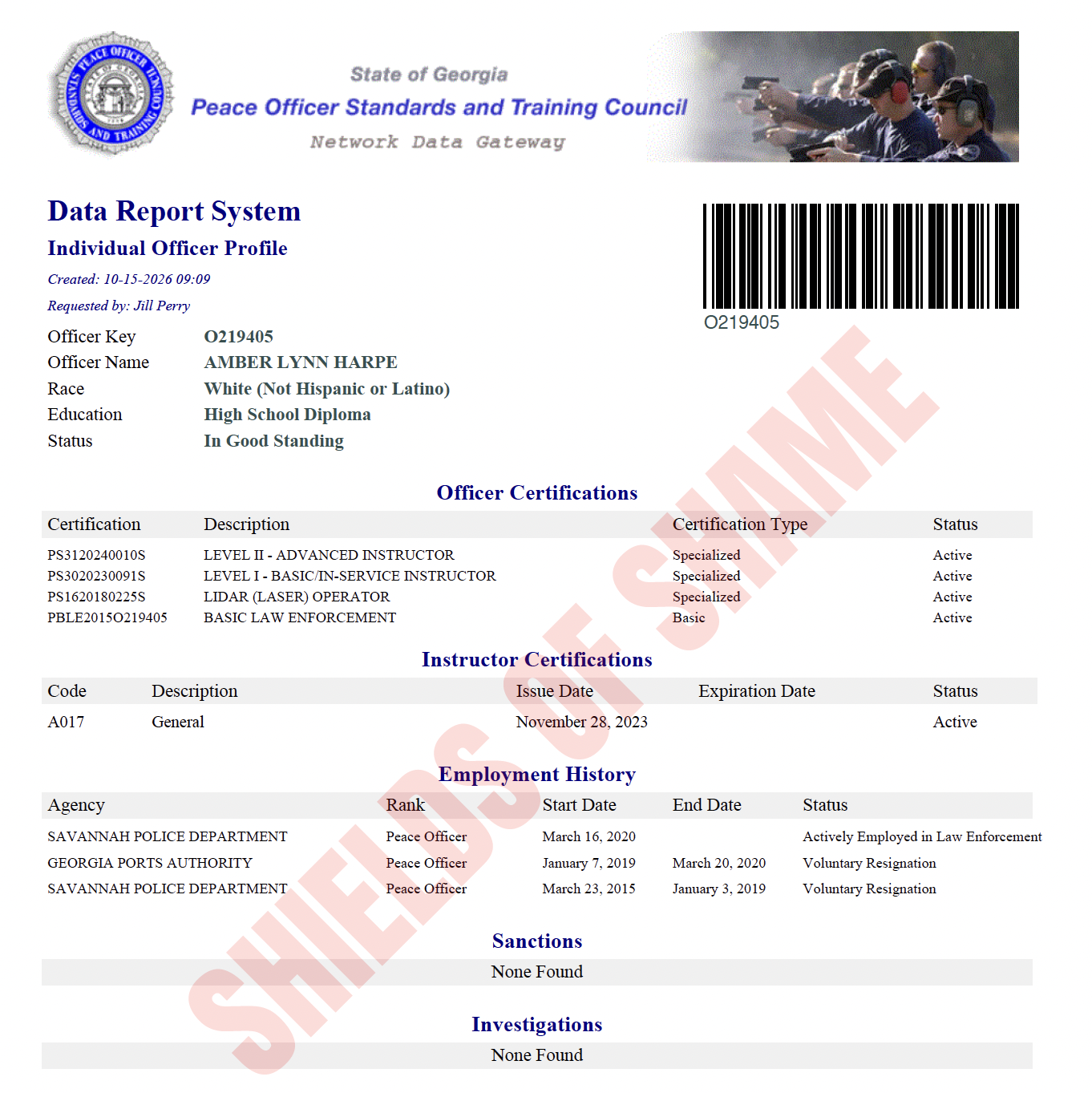
Certification image
Supplied certification-related record. Review the original for certification type, status and effective dates.
Professional training record
Training-history PDF supplied for this case. The exact courses and dates have not been independently extracted, so no training completion claims are made here.
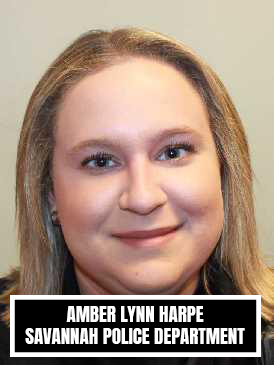
Officer photograph
Photograph supplied for the Shields of Shame case archive.
Primary reporting and official records
- WJCL investigation: Harpe and ICE access ↗
- Savannah Police: six terminations and audit reforms ↗
- GBI: arrests of four former Savannah employees ↗
- WTOC: Civil Service Board hearing and Flock training questions ↗
- Atlanta News First: Georgia Flock audit investigations ↗
Related Shields of Shame investigations
Georgia Flock Wall of Shame ↗ · Justin Keith Brown: Hall County Flock investigation ↗ · Albany Police Flock investigation ↗
Questions and answers
Was Amber Harpe arrested or convicted?
Her termination is reported. The GBI’s public August 21 announcement named four other people. No criminal charge or conviction against Harpe is established by the sources reviewed for this article.
Did her husband have permission to use her account?
According to the department records reported by WJCL, he used credentials assigned to Harpe and lacked his own DHS Flock account. Department leaders considered that access unauthorized even though he described his searches as connected to federal investigations.
What is the difference between 983 searches and 97 plates?
A search entry represents a recorded system action; a plate is a vehicle identifier. Multiple entries can relate to the same plate. The audit reportedly counted 983 entries associated with 97 identifiable plates, not 983 different vehicles.
What records should a journalist request?
Request the Flock search and access audit, user-account permissions, login and authentication logs where retained, audit-assist alerts, stated search reasons, case-number references, cross-agency sharing records, internal affairs findings, training policies, disciplinary decisions and appeal records. Request machine-readable copies and the applicable retention schedules.
Editorial standard: Distinguish employment findings, news reporting, allegations and criminal adjudications. This story describes Harpe’s reported termination and the broader Savannah investigations; it does not allege that Harpe personally executed every logged search or that her husband committed a criminal offense.